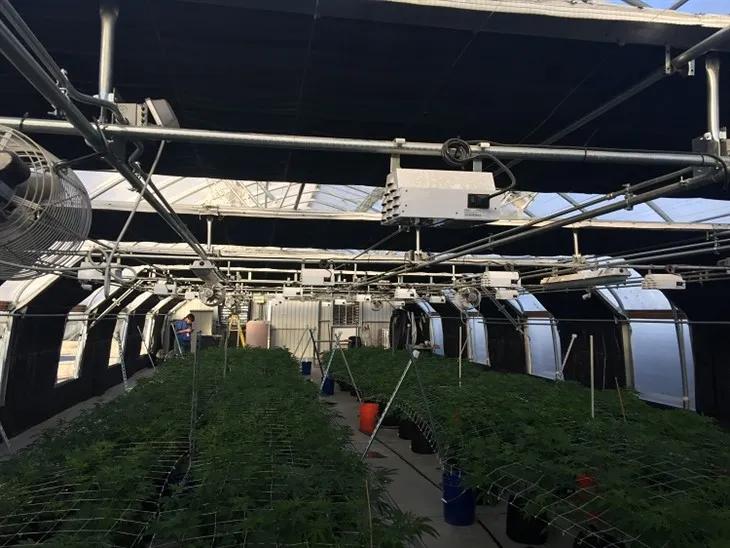
Greenhouse Blackout System for Precise Light Management
Light is one of the most important environmental factors in plant production. While natural sunlight is essential for photosynthesis, there are many commercial crops that require controlled photoperiods to achieve predictable flowering and production schedules.
This is where a greenhouse blackout system becomes an important part of a professional growing facility.

Instead of relying entirely on natural day and night cycles, growers can use blackout curtains to reduce light penetration during selected periods. The system can be operated manually or integrated with an automated greenhouse controller, allowing growers to establish repeatable lighting schedules.
For commercial flower farms, specialty crop producers, nurseries, research facilities, and controlled-environment agriculture projects, accurate light management can improve production planning while making greenhouse operations more flexible.
What Is a Greenhouse Blackout System?
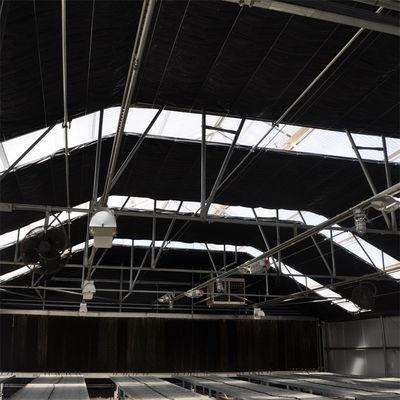
A greenhouse blackout system is a mechanical shading and light-control solution designed to significantly reduce the amount of light entering or escaping a greenhouse during a controlled period.
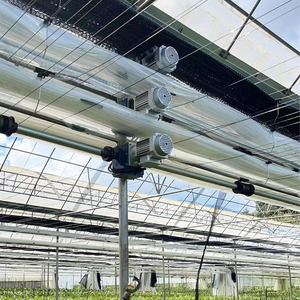
The system generally consists of:
- Blackout curtains
- Curtain tracks
- Drive motors
- Gear systems
- Support cables
- Curtain control units
- Sensors
- Automation controller
When the curtains are closed, they create a darker growing environment inside the greenhouse.
When the blackout period ends, the curtains can be retracted to allow natural sunlight back into the cultivation area.
This creates a flexible growing environment without requiring a completely enclosed indoor facility.
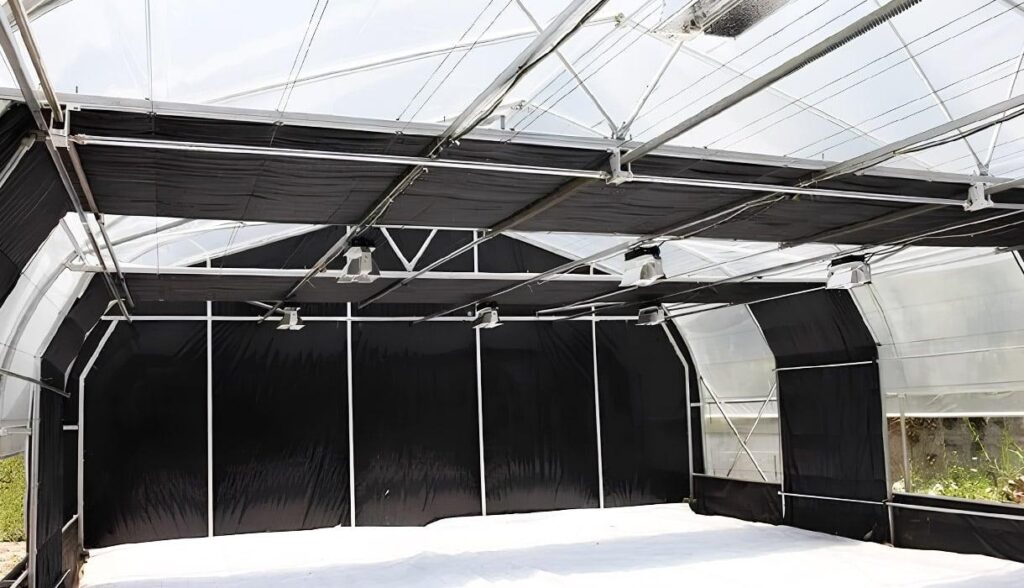
Why Light Control Matters in Commercial Cultivation
Different plants respond differently to day length.
Some crops require long daylight periods for vegetative development, while others respond to shorter photoperiods when entering reproductive stages.
Outdoor growers have limited control over seasonal daylight. A greenhouse equipped with a blackout system provides significantly more flexibility.
Growers can establish controlled schedules according to:
- Crop variety
- Growth stage
- Production calendar
- Desired flowering period
- Local daylight conditions
- Commercial harvest requirements
This can make production planning easier and more predictable.
How Does a Greenhouse Blackout System Work?
The basic operating principle is straightforward.
During the selected blackout period, the motorized drive system moves the curtain across the greenhouse.
The curtain closes over the cultivation area and reduces light transmission.
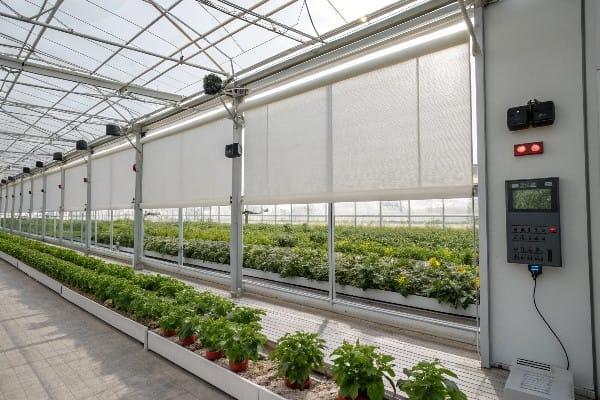
After the programmed period has finished, the controller activates the drive motor again and retracts the curtain.
A typical automated cycle may include:
Schedule → Curtain closes → Light is reduced → Blackout period → Curtain opens → Natural light returns
With sensors and timers, this process can operate automatically without workers needing to manually open and close the curtains every day.
Main Benefits of a Commercial Blackout System
1. Better Photoperiod Management
The biggest advantage is improved control over the daily light cycle.
Instead of waiting for natural seasonal changes, growers can create a customized lighting schedule.
This can be especially useful for crops where flowering behavior is influenced by day length.
2. More Flexible Production Scheduling
Commercial growers need to coordinate cultivation with market demand.
A controlled light environment can provide greater flexibility when planning production cycles.
This may help growers better coordinate:
- Planting
- Flowering
- Harvesting
- Labor
- Processing
- Distribution
3. Reduced Light Pollution
For some greenhouse operations, controlling light escaping from the building is also important.
Blackout curtains can reduce visible light escaping at night, helping minimize disturbance to surrounding areas.
This can be an important consideration for greenhouses located near residential or commercial areas.
4. Additional Solar Heat Management
Depending on the curtain material and greenhouse design, blackout curtains can also provide a degree of solar radiation control.
During periods of intense sunlight, curtains may help reduce the amount of solar energy reaching the crop.
However, blackout curtains should be considered part of a complete climate strategy rather than a replacement for ventilation or cooling equipment.
Blackout Curtain Materials
The curtain material is an important purchasing consideration.
Commercial blackout curtains are designed to provide high light-blocking performance while maintaining flexibility for repeated movement.
Common characteristics include:
High Light Blocking
The material is designed to minimize light transmission when fully closed.
Durable Construction
The curtain needs to withstand repeated opening and closing cycles.
Suitable for Greenhouse Environments
Materials should be suitable for environments with elevated humidity and temperature.
Flexible Installation
Curtains can be designed for different greenhouse structures and dimensions.
Custom Sizes
Large commercial greenhouses often require curtains manufactured according to specific span and bay dimensions.
Automatic vs. Manual Blackout Systems
Manual System
Manual systems are suitable for smaller operations where blackout curtains do not need to be opened and closed frequently.
Advantages include:
- Lower initial investment
- Simple structure
- Easy maintenance
- No complex control system
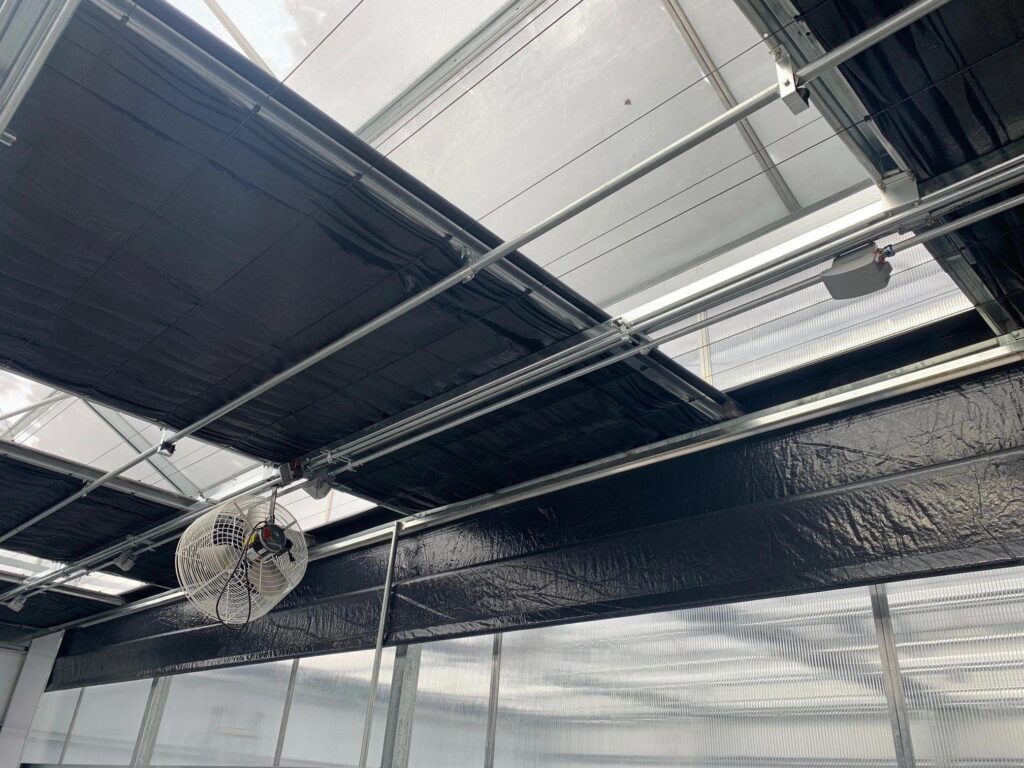
Automatic System
For commercial growers, automated operation is often more practical.
An automatic system can use motors and controllers to operate curtains according to programmed schedules.
Advantages include:
- Reduced labor
- Consistent operation
- Accurate timing
- Easy integration with climate control
- Better suitability for large facilities
For multi-greenhouse projects, automated systems can also divide the facility into separate control zones.
Integrating Blackout Curtains With Greenhouse Automation
A greenhouse blackout system becomes more powerful when connected to an integrated environmental control platform.
The controller can coordinate blackout curtains with other greenhouse equipment, including:
- Ventilation
- Cooling
- Heating
- Irrigation
- Lighting
- Humidification
- Dehumidification
For example, when blackout curtains close, internal temperature and humidity conditions may change. The climate controller can monitor these changes and activate ventilation or cooling equipment when necessary.
This coordinated approach is particularly useful for commercial production facilities where environmental conditions need to remain stable throughout the day.
Applications of Greenhouse Blackout Systems
A commercial light-deprivation system can be used in many agricultural applications.
Flower Production
Commercial flower growers can use controlled photoperiods to help coordinate flowering schedules.
Nursery Production
Blackout curtains can help manage environmental conditions for specific propagation and production stages.
Specialty Crops
Certain specialty crops require controlled day-length conditions during particular growth stages.
Research Greenhouses
Researchers can create repeatable light conditions for controlled experiments.
Commercial Greenhouses
Large-scale growers can integrate blackout systems into automated production facilities.
Important Factors When Choosing a Blackout System
Before purchasing a greenhouse blackout system, commercial buyers should evaluate several factors.
Greenhouse Dimensions
Curtain size and drive configuration must match the greenhouse structure.
Curtain Coverage
The system should be designed to provide appropriate coverage for the intended cultivation area.
Light Blocking Performance
Buyers should consider the required light-control level for the crop and application.
Motor Capacity
The motor must be appropriately sized for curtain weight, span, and movement resistance.
Control Method
Options may include manual controls, timers, PLC systems, or integrated smart greenhouse controllers.
Local Climate
Curtain operation should be coordinated with ventilation and cooling in hot climates.
Maintenance
The system should provide convenient access to motors, tracks, and curtain components for routine inspection.
Technical Parameters
| Parameter | Typical Specification |
|---|---|
| System Type | Blackout / Light Deprivation |
| Curtain Material | Multi-Layer Blackout Fabric |
| Light Blocking | High Light Blocking |
| Drive System | Motorized / Manual |
| Motor | Tubular / Gear Motor |
| Control | Manual / Timer / PLC |
| Curtain Width | Customized |
| Curtain Length | Customized |
| Installation | Internal / External |
| Automation | Optional |
| Climate Control Integration | Available |
| Application | Commercial Greenhouse |
| OEM/ODM | Available |
Final specifications should be confirmed according to greenhouse structure, curtain dimensions, climate conditions, and project requirements.
Why Choose Good Growing Tech?
Good Growing Tech provides customized greenhouse equipment and environmental control solutions for commercial agricultural projects.
Our solutions can integrate:
✔ Greenhouse blackout curtains
✔ Light deprivation systems
✔ Internal shading systems
✔ External shading systems
✔ Motorized curtain systems
✔ Greenhouse ventilation
✔ Cooling equipment
✔ Heating systems
✔ Irrigation
✔ Climate control
This allows buyers to develop a complete environmental management solution instead of purchasing disconnected equipment from different suppliers.
For greenhouse contractors, agricultural distributors, commercial growers, and project developers, we can customize the system according to greenhouse dimensions, crop requirements, local climate, and automation requirements.
FAQs:
What is a greenhouse blackout system used for?
It is primarily used to control the amount of natural light entering a greenhouse and create a controlled photoperiod.
Can blackout curtains be automated?
Yes. Motorized curtains can be connected to timers, PLC controllers, environmental sensors, or smart greenhouse control systems.
Do blackout curtains completely block sunlight?
The actual light-blocking performance depends on the curtain material, installation quality, overlapping design, and greenhouse structure. The final system should be selected according to the required level of light control.
Can blackout curtains help reduce heat?
They can reduce solar radiation reaching the crop in certain operating conditions, but they should work together with ventilation and cooling equipment for effective temperature management.
Are blackout systems suitable for large commercial greenhouses?
Yes. Motorized systems can be designed for large spans and divided into multiple control zones.
Can the curtain size be customized?
Yes. Curtain dimensions, drive configuration, material, control method, and installation design can be customized according to the greenhouse project.
Conclusion
A well-designed greenhouse blackout system gives commercial growers greater control over one of the most important variables in plant production: light.
By reducing dependence on natural day-length changes, growers can create more controlled production schedules and integrate photoperiod management with other greenhouse technologies.
For commercial flower farms, nurseries, specialty crop producers, research facilities, and modern controlled-environment agriculture projects, automated blackout curtains can provide an effective combination of flexibility, labor savings, and environmental control.
The best results come from designing the blackout system together with ventilation, cooling, shading, and climate automation rather than treating it as an isolated greenhouse accessory.
Good Growing Tech can provide customized light-control and greenhouse automation solutions for commercial agricultural projects.
Contact Us
📧 Email: arno@goodgrowingtech.com
🌐 Website: www.goodgrowingtech.com
📱 WhatsApp: +86 18056416155
🏢 Good Growing Tech – Professional Greenhouse Blackout & Smart Agriculture Solutions