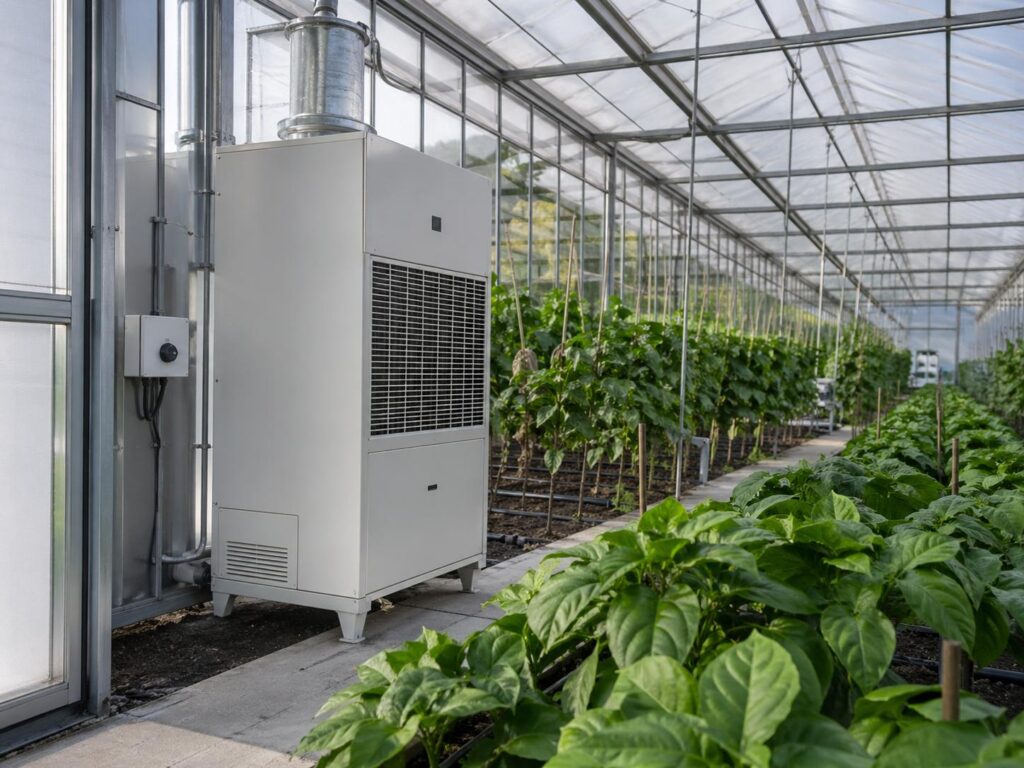
Greenhouse Dehumidification System for Stable Crop Conditions
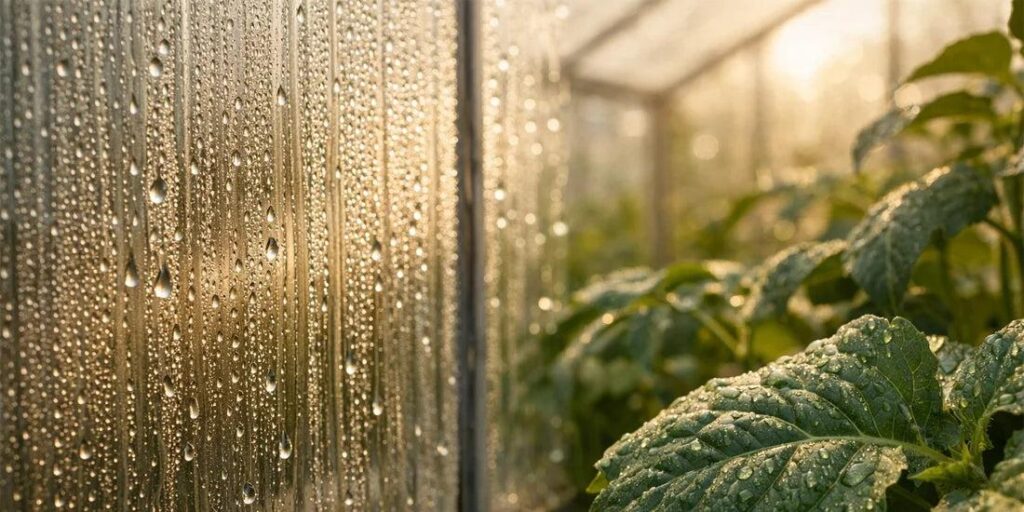
Managing humidity inside a greenhouse can be just as important as controlling temperature. During cool nights, rainy periods, or high-humidity seasons, moisture can accumulate inside the growing environment. When this happens repeatedly, condensation may form on greenhouse coverings, leaves, structures, and equipment.
A greenhouse dehumidification system provides a controlled way to remove excess moisture from greenhouse air. Instead of relying entirely on ventilation, commercial growers can combine dehumidification equipment with heating, circulation fans, roof ventilation, and climate-control systems to create a more stable environment.
This is particularly useful for greenhouses operating in humid climates or facilities where ventilation alone cannot provide enough humidity control.
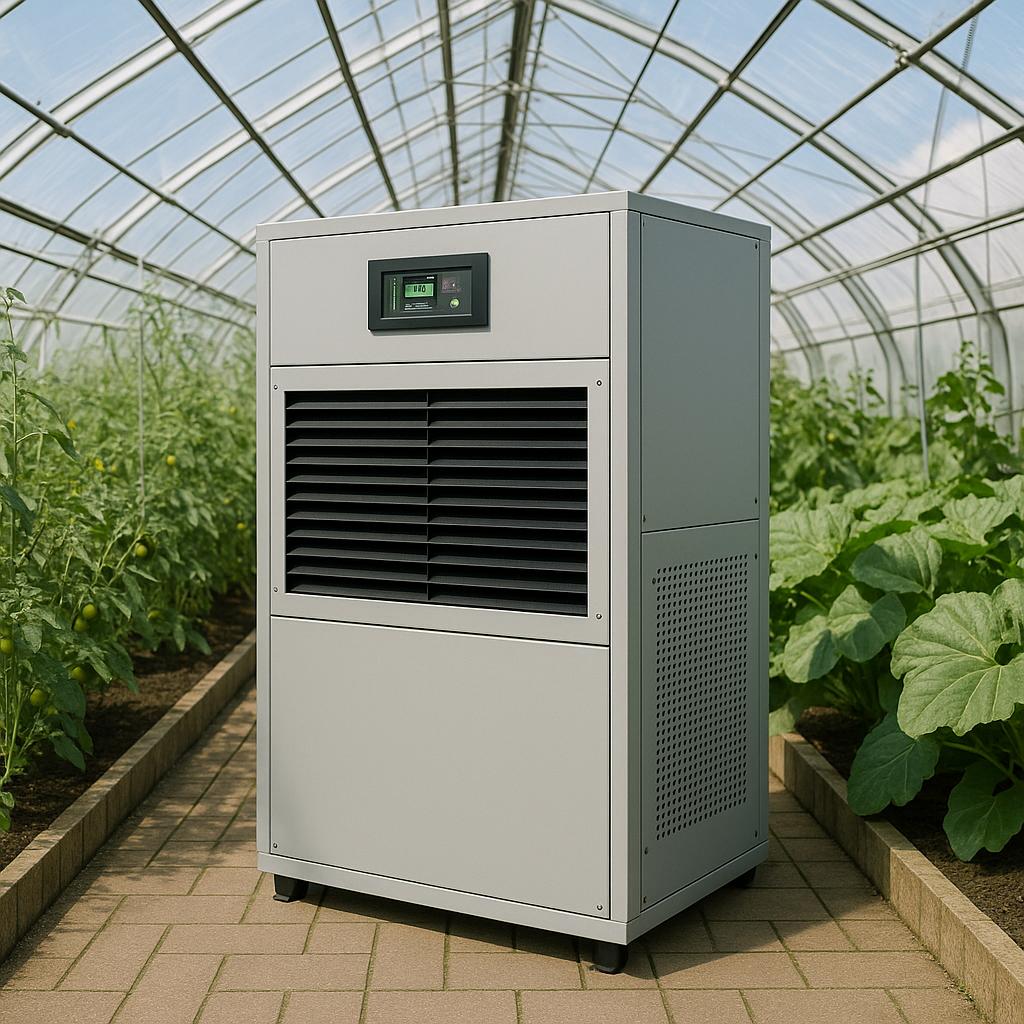
What Is a Greenhouse Dehumidification System?
A greenhouse dehumidification system is designed to remove excess moisture from the air inside a greenhouse.
The system can use different technologies depending on the project, including:
- Refrigeration-based dehumidifiers
- Condensing dehumidifiers
- Desiccant systems
- Ventilation-assisted dehumidification
- Heating and ventilation combinations
- Integrated HVAC systems
For commercial greenhouse applications, the most appropriate solution depends on greenhouse volume, climate, crop type, operating temperature, and the required humidity range.
A complete installation may also include humidity sensors, temperature sensors, controllers, drainage systems, and automatic ventilation controls.
Why Is Humidity Control Important?
Plants naturally release water vapor through transpiration. In a closed greenhouse, this moisture can accumulate quickly, particularly when air movement is limited.
The problem becomes more noticeable when nighttime temperatures fall.
Warm, moisture-rich air can reach surfaces that have become cooler than the surrounding air. This can lead to condensation.
A properly designed dehumidification strategy can help manage this moisture load.
Reduce Excess Moisture
The primary purpose is to remove water vapor when humidity becomes too high.
Reduce Condensation Risk
Lowering excessive humidity can help reduce condensation on greenhouse structures and other cold surfaces.
Improve Environmental Consistency
Humidity control can make the growing environment more predictable, especially when outdoor conditions change rapidly.
Support Climate Management
Dehumidification works alongside heating, ventilation, and air circulation rather than replacing them.
Improve Comfort for Workers and Equipment
Excessively humid conditions can also affect working conditions and contribute to moisture accumulation around electrical or mechanical equipment.
How Does Greenhouse Dehumidification Work?
The operating principle depends on the technology used.
Refrigeration Dehumidification
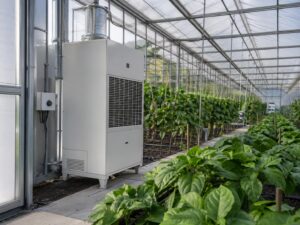
A refrigeration-based dehumidifier pulls humid greenhouse air through a cooled heat exchanger.
As the air temperature falls below its dew point, water vapor condenses into liquid water. The collected water is then drained away, while the treated air is returned to the greenhouse.
This type of system can be useful where greenhouse temperatures remain within the operating range required by the equipment.
Desiccant Dehumidification
Desiccant systems use moisture-absorbing materials to remove water vapor from the air.
They can be considered for specialized applications where low humidity levels are required or where conventional refrigeration systems are less suitable.
Ventilation-Based Dehumidification
In suitable outdoor conditions, greenhouse ventilation can remove humid internal air and replace it with drier outside air.
This method can be relatively simple, but its effectiveness depends heavily on outdoor temperature and humidity.
During cold or very humid weather, ventilation alone may not be sufficient.
Greenhouse Dehumidification During the Night
Nighttime is often one of the most challenging periods for greenhouse humidity control.
Plants continue to release moisture, while greenhouse temperatures may fall. At the same time, growers may want to keep vents closed to conserve heat.
This creates a difficult balance:
Close the greenhouse too much → humidity increases.
Ventilate too aggressively → heat is lost.
A smart dehumidification strategy can help solve this problem.
For example, the climate controller can monitor temperature and relative humidity and determine when dehumidification, heating, ventilation, or circulation should operate.
This approach is particularly useful for commercial greenhouses that need stable environmental conditions throughout the night.
Dehumidification and Greenhouse Heating
Heating and dehumidification are closely connected.
When air is heated, its relative humidity can decrease. However, heating alone does not remove the actual moisture from the greenhouse.
If the greenhouse contains a large amount of water vapor, simply increasing the temperature may temporarily reduce relative humidity without actually removing the moisture load.
A more complete strategy can combine:
- Heating
- Dehumidification
- Air circulation
- Controlled ventilation
- Humidity sensors
Circulation fans are particularly useful because they help distribute air throughout the greenhouse and reduce stagnant zones.
Dehumidification and Ventilation
Ventilation is one of the most important tools for humidity management.
When outdoor air is suitable, opening roof or side vents can allow humid greenhouse air to escape.
However, ventilation has limitations.
During winter, opening vents can release valuable heat. In regions with high outdoor humidity, ventilation may also provide limited dehumidification.
For this reason, commercial greenhouse projects may use a combination of mechanical dehumidification and controlled ventilation.
The controller can select the most appropriate strategy based on current environmental conditions.
Dehumidification for Different Greenhouse Applications
Humidity requirements vary between production systems.
Vegetable Greenhouses
Vegetable production can generate significant amounts of moisture through plant transpiration. Proper humidity management becomes especially important in dense crop areas.
Flower Greenhouses
Ornamental plants can have specific environmental requirements, making precise climate control valuable for commercial production.
Nursery Greenhouses
Propagation and young-plant areas may require carefully controlled temperature and humidity conditions.
Hydroponic Greenhouses
Hydroponic systems can create a high-moisture environment because water is continuously circulated around the growing system. Dehumidification can therefore become an important part of the overall climate strategy.
Indoor Farming Facilities
Fully enclosed growing facilities may have limited natural ventilation, making mechanical dehumidification particularly important.
How to Choose a Greenhouse Dehumidification System
Choosing equipment based only on room size is not enough for a commercial greenhouse.
1. Greenhouse Volume
The total enclosed air volume influences the required dehumidification capacity.
2. Crop Transpiration
The amount of moisture generated by plants can vary considerably depending on crop type, plant density, growth stage, temperature, and irrigation strategy.
3. Local Climate
Outdoor temperature and humidity determine how useful natural ventilation will be.
4. Greenhouse Covering
Glass, polycarbonate, and film-covered structures have different thermal characteristics and can affect condensation behavior.
5. Irrigation Method
Hydroponics, drip irrigation, ebb-and-flow benches, and other systems introduce different amounts of moisture into the greenhouse environment.
6. Desired Automation
For commercial operations, automated humidity control can reduce manual work and provide more consistent environmental management.
Smart Greenhouse Dehumidification
A modern greenhouse can connect the dehumidification system to a central climate controller.
A typical control sequence may work like this:
- Humidity sensors measure the greenhouse environment.
- The controller compares the reading with the programmed range.
- The system checks temperature and other climate conditions.
- Dehumidification equipment starts when required.
- Circulation fans distribute air through the greenhouse.
- Ventilation may be adjusted according to outdoor conditions.
- The system stops or reduces operation after the target condition is reached.
This type of coordinated control is much more efficient than operating each piece of equipment independently.
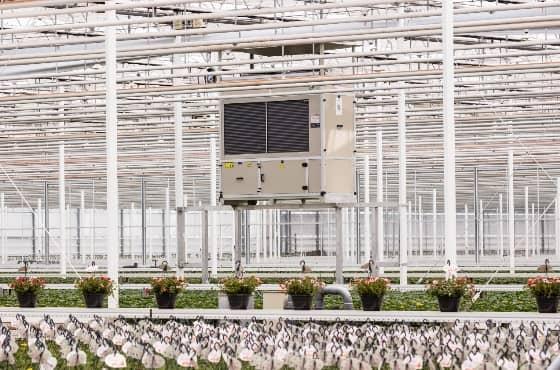
Technical Parameters
The following table provides a general reference for commercial greenhouse projects. Final specifications should be determined according to greenhouse dimensions, local climate, crop transpiration, irrigation method, and required humidity control.
| Parameter | Typical / Optional / Customized |
|---|---|
| System Type | Refrigeration / Desiccant / Ventilation-Assisted |
| Application | Greenhouse / Indoor Farming / Nursery |
| Dehumidification Capacity | Project Dependent |
| Operating Temperature | Project Dependent |
| Airflow | Customized |
| Power Supply | 220V / 380V / Customized |
| Compressor | Optional / Project Selected |
| Refrigerant | Model Dependent |
| Humidity Sensor | Optional / Automatic System |
| Temperature Sensor | Optional |
| Controller | Digital Controller / PLC |
| Control Mode | Manual / Timer / Automatic |
| Drainage | Automatic / Customized |
| Dehumidification Zones | Customized |
| Ventilation Integration | Available |
| Heating Integration | Available |
| Circulation Fan Integration | Available |
| Remote Monitoring | Optional |
| Communication | RS485 / Internet / Customized |
| Installation | Indoor / Greenhouse / Customized |
| OEM/ODM | Available |
Maintenance Requirements
A dehumidification system should be maintained regularly to keep performance stable.
Clean air filters. Dust and plant debris can restrict airflow and reduce efficiency.
Inspect drainage. Condensed water needs a reliable drainage route.
Check sensors. Incorrect humidity readings can cause unnecessary operation or insufficient moisture removal.
Clean heat exchangers. Depending on the system, dust and debris can accumulate on heat-transfer surfaces.
Inspect electrical connections. Commercial greenhouse environments can be humid, making electrical inspection particularly important.
Monitor operating performance. Unusual noise, airflow changes, water leakage, or temperature abnormalities should be investigated promptly.
Greenhouse Dehumidification from Good Growing Tech
Good Growing Tech provides greenhouse equipment and integrated climate-control solutions for commercial agricultural projects.
Dehumidification can be designed together with:
- Greenhouse heating
- Exhaust fans
- Circulation fans
- Roof ventilation
- Side ventilation
- Cooling systems
- Humidification
- Irrigation
- Fertigation
- Shading systems
- Climate sensors
- Central automation
Instead of selecting a dehumidifier independently, Good Growing Tech can help configure the system according to the greenhouse structure, production requirements, climate conditions, and desired automation level.
This project-based approach is especially useful for large commercial installations where humidity, temperature, airflow, and energy consumption need to be considered together.
FAQs:
Why do greenhouses need dehumidification?
Plants naturally release moisture through transpiration. In closed or poorly ventilated greenhouses, this moisture can accumulate and increase humidity and condensation.
Is ventilation enough to control greenhouse humidity?
Sometimes, but not always. Ventilation works best when outdoor air is suitable. During cold or humid weather, mechanical dehumidification may provide better control.
Can heating reduce greenhouse humidity?
Heating can reduce relative humidity, but it does not directly remove moisture from the greenhouse. Dehumidification physically removes water vapor.
Can dehumidification work with circulation fans?
Yes. Circulation fans can help distribute humid air toward the dehumidification equipment and reduce stagnant zones.
Can a greenhouse dehumidification system be automated?
Yes. Humidity and temperature sensors can be connected to controllers, allowing the system to operate automatically according to programmed conditions.
Is dehumidification useful for hydroponic greenhouses?
Yes. Hydroponic production can generate substantial moisture, particularly in enclosed environments, making humidity control an important part of the overall climate-management strategy.
Conclusion
A well-designed greenhouse dehumidification system can help commercial growers manage excess moisture, reduce condensation, and maintain a more stable production environment. The most effective solution is rarely based on a single piece of equipment. Heating, ventilation, circulation, irrigation, and humidity control should work together.
For commercial greenhouse projects, the system should be sized according to greenhouse volume, crop transpiration, climate conditions, irrigation method, and the desired level of automation.
Looking for a customized greenhouse humidity-control solution? Contact Good Growing Tech for greenhouse equipment and integrated climate-control support.
📧 Email: arno@goodgrowingtech.com
🌐 Website: www.goodgrowingtech.com
📱 WhatsApp: +86 18056416155