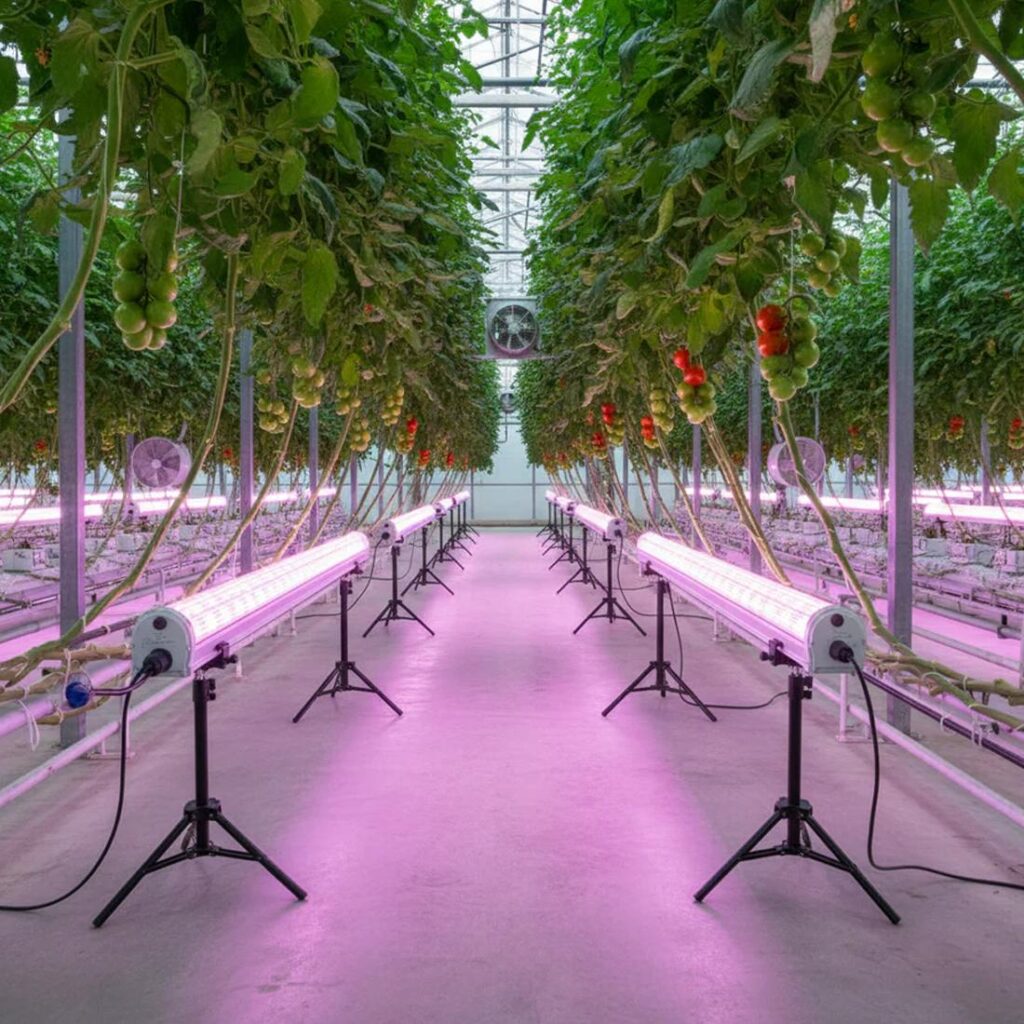
Greenhouse Grow Lights for Year-Round Commercial Crop Production
Natural sunlight is essential for greenhouse crops, but it does not always provide enough light for consistent production throughout the year. Short winter days, cloudy weather, greenhouse structures, and shading systems can all reduce the amount of light reaching plants.
For commercial growers, insufficient light can affect crop development, production scheduling, and the consistency of harvests. A properly designed greenhouse grow lights system provides supplemental lighting when natural sunlight alone cannot meet crop requirements.
LED technology has become an important option for greenhouse lighting because it allows growers to select suitable light spectra, control operating schedules, and distribute light across designated growing areas. However, choosing the right lighting solution involves more than comparing wattage or the number of fixtures. Crop type, canopy height, greenhouse layout, target light intensity, and electricity costs all influence the final design.
Good Growing Tech provides greenhouse equipment and integrated growing solutions that can be configured around the requirements of commercial agricultural projects.
What Are Greenhouse Grow Lights?
Greenhouse grow lights are artificial lighting systems designed to supplement or, in some facilities, replace natural sunlight for plant production.
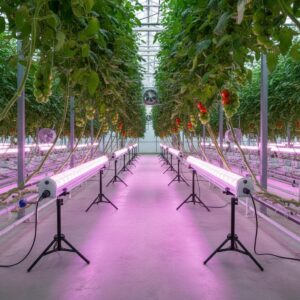
Unlike ordinary indoor lighting, horticultural lighting is designed around the light requirements of plants. The system may use LED fixtures positioned above the canopy, interlighting fixtures placed between crop rows, or specialized lighting for propagation benches.
Commercial greenhouse lighting is commonly used for:
- Supplemental lighting during winter
- Production in regions with limited sunlight
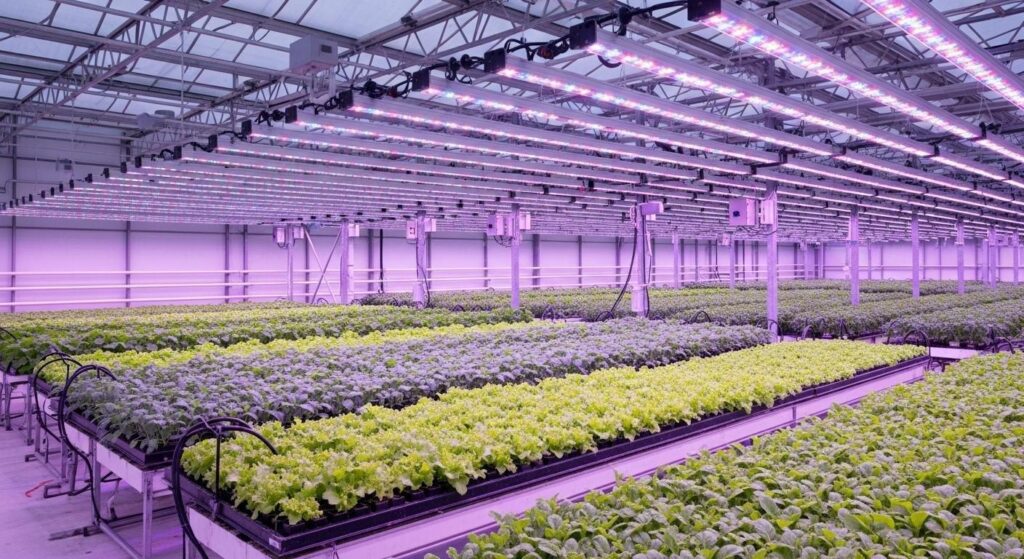
- Seedling and propagation areas
- High-density crop production
- Vertical growing systems
- Research and controlled-environment agriculture
The appropriate setup depends on the crop’s light requirements and the amount of natural sunlight already available.
Why Commercial Growers Use Supplemental Lighting
1. Compensate for Low Natural Light
Natural light levels change throughout the day and across seasons. During cloudy periods or short winter days, supplemental lighting can help maintain a more consistent daily light supply.
2. Support More Predictable Production
When light availability fluctuates significantly, plant development can become less predictable. A controlled lighting schedule helps growers manage the light environment more consistently.
3. Improve Light Distribution
In dense crop canopies, upper leaves may intercept much of the available sunlight. Interlighting and carefully positioned fixtures can help deliver additional light to selected areas of the canopy.
4. Support Propagation
Seedlings and young plants need suitable light conditions for healthy development. Dedicated lighting above propagation benches can help growers maintain a more controlled production environment.
5. Enable Flexible Production Planning
Supplemental lighting may give growers more flexibility when planning production during darker seasons. Its economic value depends on crop value, electricity prices, lighting efficiency, and the expected production response.
LED Greenhouse Lighting: How It Works
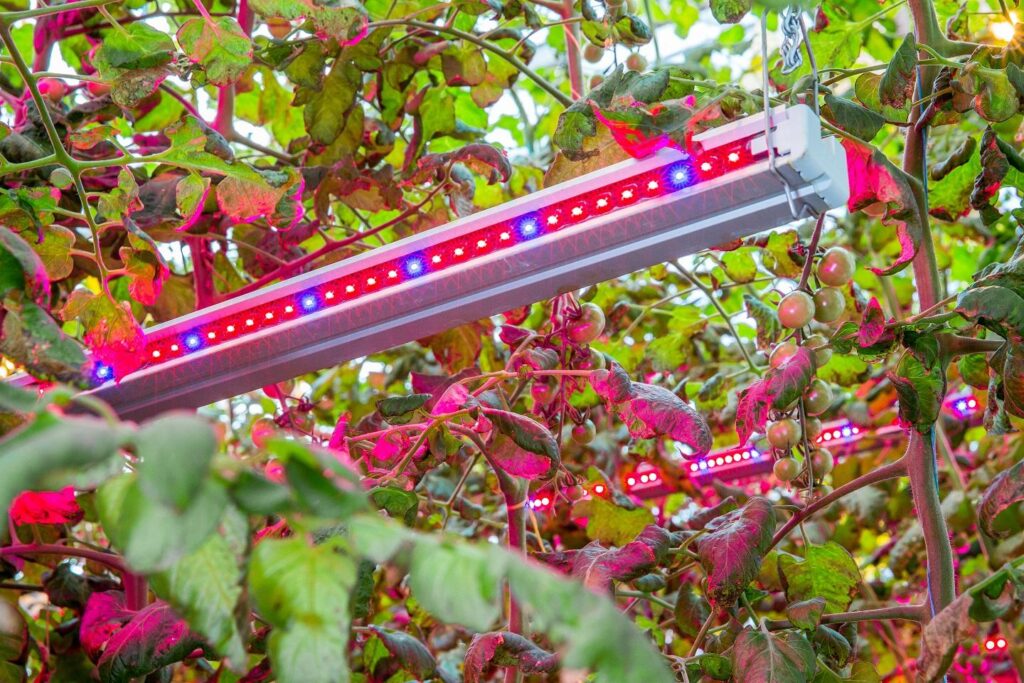
LED grow lights convert electrical energy into light that plants can use for photosynthesis and other light-dependent processes.
A commercial LED fixture typically includes LED chips, a driver, a heat-management structure, optical components, and mounting hardware. Some models also support dimming or networked control.
Compared with traditional horticultural lighting technologies, LED fixtures can offer greater flexibility in spectrum selection and light distribution. Their actual efficiency, service life, and operating costs depend on the fixture design and installation conditions.
When comparing products, buyers should look beyond the rated wattage and review the actual horticultural performance data.
Understanding PAR, PPFD, and DLI
Three lighting measurements are particularly useful when planning a greenhouse lighting project.
| Measurement | What It Means | Why It Matters |
|---|---|---|
| PAR | Photosynthetically active radiation, conventionally defined as light from 400–700 nm | Describes the wavelength range commonly considered for photosynthesis |
| PPFD | Photosynthetic photon flux density, measured in µmol/m²/s | Measures the amount of photosynthetic photons reaching a unit area each second |
| DLI | Daily light integral, measured in mol/m²/day | Measures the total daily photosynthetic light received by a unit area |
PPFD helps growers understand light intensity at a specific point, while DLI accounts for light received over the entire day.
For example, a greenhouse may receive adequate light around midday but insufficient light during the early morning and late afternoon. Supplemental lighting can be scheduled to address these periods, provided the crop’s total daily light requirement and operating economics justify it.
A professional lighting design should account for both sunlight and artificial lighting rather than treating the LED system as the only light source.
Choosing the Right LED Light Spectrum
Different crops and growth stages can respond differently to light spectrum. A lighting product should therefore be selected according to the crop and production objective.
Full-Spectrum LED Grow Lights
Full-spectrum fixtures provide a broad light distribution intended for general horticultural use. They can be suitable for a range of greenhouse crops, depending on their output and spectrum.
Red and Blue LED Lighting
Red and blue wavelengths are relevant to photosynthesis and plant development. Some specialized fixtures emphasize these wavelengths, although the best spectrum depends on the crop and the intended outcome.
White-Light LED Fixtures
White-light fixtures can make it easier for workers to inspect crop appearance under artificial lighting. Their suitability depends on the spectral output and total photon delivery.
Custom-Spectrum Lighting
Some projects require a specific spectral configuration for a particular crop, research program, or production process. Customization should be supported by reliable spectral data rather than marketing descriptions alone.
No single spectrum is automatically best for every greenhouse. Crop species, growth stage, ambient sunlight, and the production objective should guide the selection.
Top Lighting vs. Interlighting
The physical position of the fixtures affects how light reaches the crop.
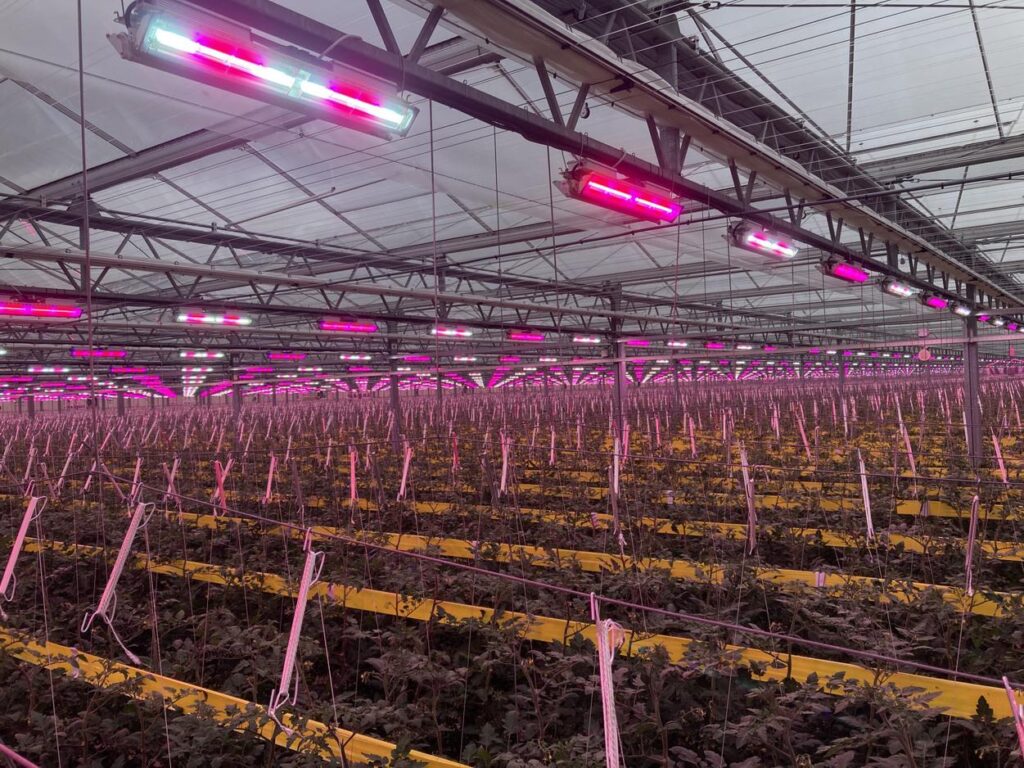
Top lighting places fixtures above the crop canopy. It is widely used for general supplemental lighting and can cover large growing areas.
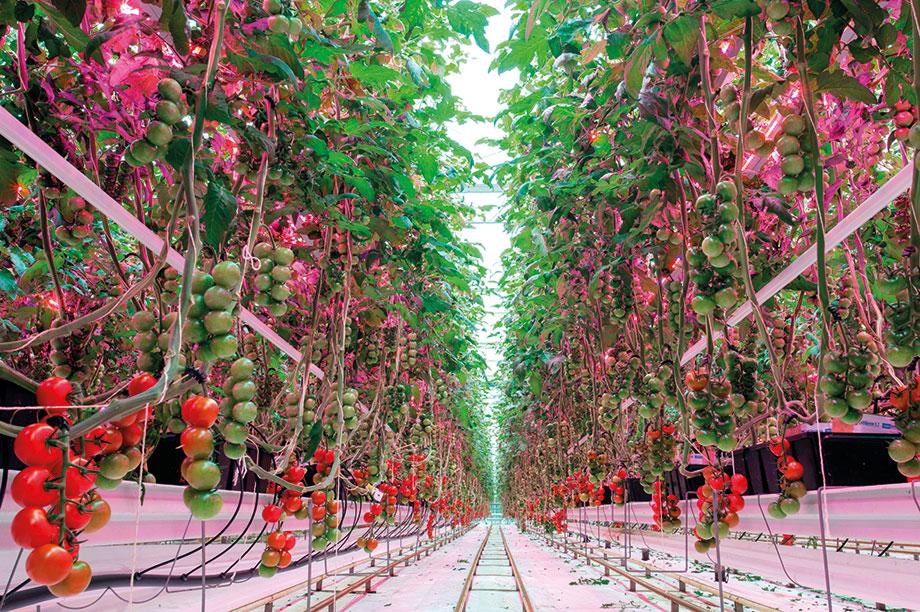
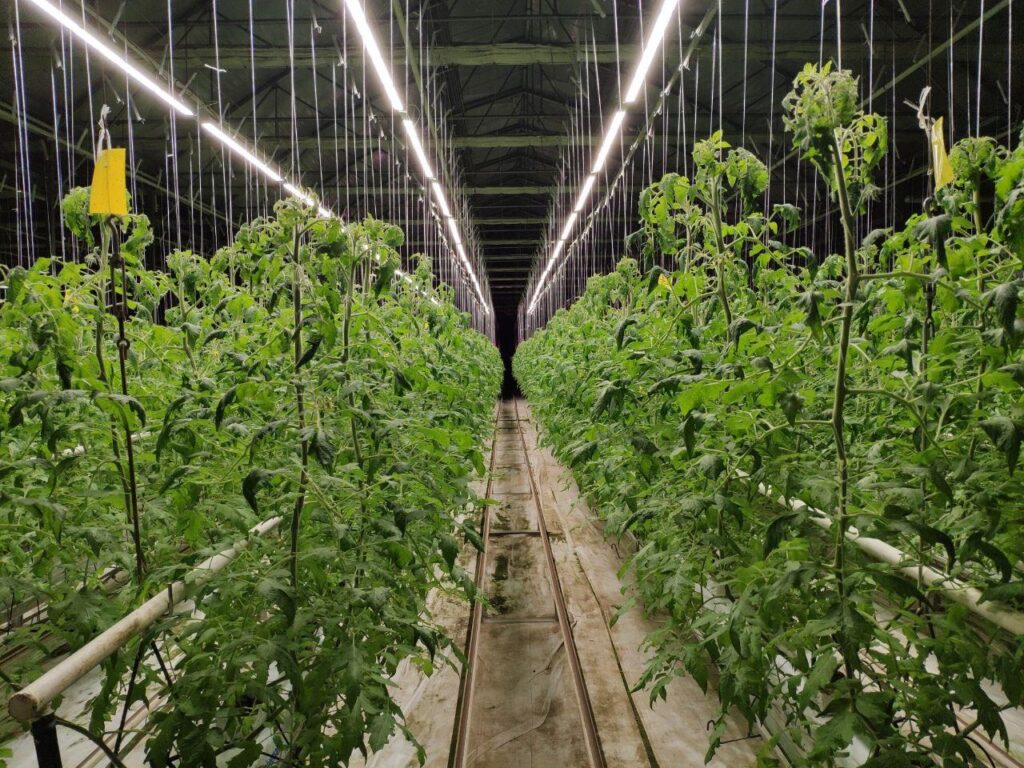
Interlighting positions fixtures within or between crop rows. It can deliver light to parts of tall or dense canopies that receive less sunlight from above.
The two approaches can also be combined. For example, a commercial greenhouse may use top lighting for the overall crop area and interlighting in selected rows where canopy structure makes additional light useful.
The final design should consider plant height, row spacing, maintenance access, fixture protection, and the risk of uneven light distribution.
How to Plan a Commercial Greenhouse Lighting System
Before choosing fixtures, buyers should define the lighting objective.
Step 1: Identify the crop. Tomatoes, cucumbers, leafy vegetables, flowers, and seedlings can have different light requirements.
Step 2: Measure the growing area. Record greenhouse dimensions, row spacing, canopy height, and any structural obstructions.
Step 3: Assess natural sunlight. Seasonal light availability affects how much supplemental lighting is required.
Step 4: Set the target light level. Establish the desired PPFD and daily light integral based on crop needs and the production plan.
Step 5: Calculate fixture placement. Photometric or horticultural lighting calculations help estimate fixture quantity, mounting height, spacing, and light uniformity.
Step 6: Review energy costs. Estimate daily operating hours and electricity consumption before selecting the final configuration.
Step 7: Plan controls and maintenance. Decide whether the installation needs dimming, scheduled operation, remote monitoring, or integration with a greenhouse controller.
Energy Efficiency and Lighting Control
Lighting can become a significant operating expense in commercial greenhouse production. Fixture efficiency is important, but the way the system is operated also affects total energy consumption.
Useful considerations include:
- Comparing fixture efficacy in µmol/J
- Using dimming where appropriate
- Scheduling lighting around natural sunlight
- Avoiding unnecessary lighting during periods of sufficient natural light
- Selecting suitable fixture spacing
- Keeping lenses and optical surfaces clean
- Checking driver and electrical performance
- Integrating lighting schedules with climate-control operations
An automated system may use light sensors or a programmed schedule to manage operation. More advanced installations can coordinate lighting with environmental monitoring and production schedules.
However, automatic control should be configured around crop requirements. Reducing electricity use is valuable only when the resulting light supply remains suitable for the intended production target.
Technical Parameters for Commercial Greenhouse Grow Lights
The following table is a general purchasing reference. Actual specifications vary by fixture model and project requirements.
| Parameter | Typical / Optional / Customized |
|---|---|
| Product Type | LED Greenhouse Grow Light |
| Lighting Application | Supplemental / Controlled-Environment Lighting |
| Light Spectrum | Full Spectrum / Red-Blue / Customized |
| Power Rating | Model Dependent |
| Photon Efficacy | Manufacturer-Tested Specification |
| PPFD | Depends on Fixture, Height, and Layout |
| Beam Distribution | Model Dependent |
| Dimming | Optional / Model Dependent |
| Control Method | Manual / Timer / 0–10V / Digital Control |
| Fixture Installation | Suspended / Rail Mounted / Customized |
| Housing | Aluminum / Project Specific |
| Heat Management | Passive / Model Dependent |
| Power Supply | Voltage and Frequency Customized |
| Ingress Protection | Model Dependent |
| Photoperiod Scheduling | Optional |
| Light Sensor Integration | Optional |
| Greenhouse Automation Integration | Project Dependent |
| Application | Vegetables / Flowers / Nursery / Research |
| OEM/ODM | Subject to Project Requirements |
Buyer tip: Request a product datasheet that includes measured photon efficacy, spectral distribution, electrical power, and photometric or PPFD distribution information. These details make it easier to compare fixtures on a consistent basis.
Common Mistakes When Buying Greenhouse Grow Lights
Choosing Fixtures by Wattage Alone
A higher wattage does not automatically mean a fixture delivers more useful light to the crop. Compare photon output, efficacy, and distribution data.
Ignoring Natural Sunlight
A greenhouse with abundant sunlight may need a different lighting configuration from one operating through a dark winter season.
Using the Same Layout for Every Crop
Tall crops, compact leafy crops, and propagation benches have different canopy structures. Fixture placement should reflect these differences.
Overlooking Electrical and Installation Requirements
Power supply, mounting hardware, cable routing, moisture exposure, and maintenance access should be reviewed before installation.
Ignoring the Total Cost of Ownership
The purchase price is only one part of the investment. Energy consumption, maintenance, replacement needs, and expected production benefits should also be evaluated.
Applications of Greenhouse LED Lighting
Greenhouse Grow Lights from Good Growing Tech
Commercial LED lighting can be used in a variety of growing environments:
- Vegetable greenhouses: Supplemental lighting for crops such as tomatoes, cucumbers, and leafy vegetables.
- Flower production: Lighting configurations selected for the crop’s growth and production requirements.
- Plant nurseries: Lighting for seedlings, propagation benches, and young plants.
- Hydroponic greenhouses: Integration with irrigation, fertigation, and environmental controls.
- Research facilities: Repeatable lighting schedules for controlled growing trials.
- Indoor farming: Artificial lighting designed around the growing system and available space.
Good Growing Tech provides greenhouse equipment and integrated growing solutions for commercial agricultural projects. Lighting can be considered alongside greenhouse structure, ventilation, cooling, heating, irrigation, fertigation, and climate automation.
For each project, the lighting configuration should be matched to the crop, growing area, available sunlight, target light level, operating schedule, and budget.
Whether the requirement is supplemental lighting for a commercial greenhouse or a more controlled LED lighting setup for indoor growing, the aim is to build a practical solution around the production environment rather than simply supplying fixtures.
FAQs:
Are LED grow lights suitable for commercial greenhouses?
Yes. LED fixtures can supplement natural sunlight and provide controlled lighting schedules. Suitability depends on the crop, available sunlight, fixture performance, and operating economics.
What is the difference between PPFD and DLI?
PPFD measures photosynthetic photon delivery at a particular moment, while DLI measures the accumulated photosynthetic light received over a full day.
Should I choose full-spectrum or red-blue LED grow lights?
The choice depends on the crop, production goals, natural light conditions, and fixture performance. Full-spectrum lighting is a flexible option, but no spectrum is universally best.
Can greenhouse grow lights be automated?
Yes. Many systems support scheduled operation, dimming, or integration with a greenhouse controller. The available functions depend on the fixture and control equipment.
How many LED grow lights does a greenhouse need?
The required quantity depends on growing area, target PPFD, fixture photon output, mounting height, spacing, and light distribution. A lighting layout calculation is recommended before purchasing.
Can LED grow lights reduce energy costs?
They may reduce electricity consumption compared with less efficient lighting technologies when delivering comparable useful light, but actual savings depend on the products being compared and how the system is operated.
Conclusion
A well-planned greenhouse grow lights installation can help commercial growers manage supplemental light more precisely and support production during periods when natural sunlight is insufficient. The best solution combines suitable LED fixtures, an appropriate spectrum, correct placement, reliable performance data, and practical lighting controls.
Before investing, assess the crop’s light requirements, seasonal sunlight, target DLI, electricity costs, and greenhouse layout. These factors will help determine whether supplemental lighting is worthwhile and which configuration best fits the project.
Looking for a customized greenhouse lighting solution? Contact Good Growing Tech to discuss your greenhouse equipment and growing-system requirements.
📧 Email: arno@goodgrowingtech.com
🌐 Website: www.goodgrowingtech.com
📱 WhatsApp: +86 18056416155