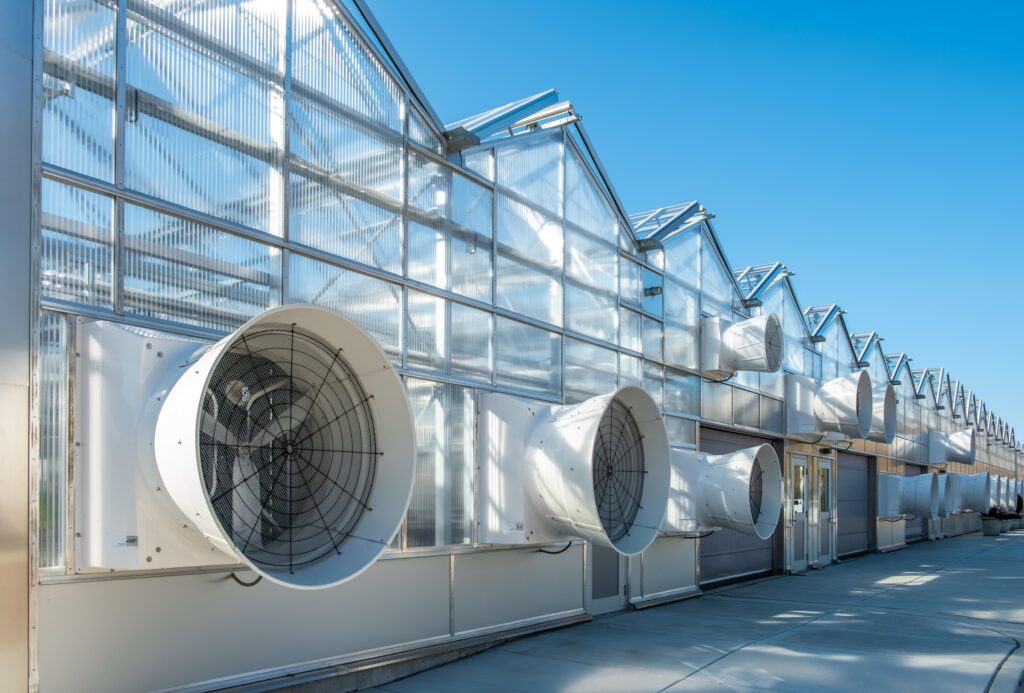
Greenhouse Circulation Fan for More Uniform Growing Conditions
Good ventilation is not only about bringing fresh air into a greenhouse. Once that air enters, it also needs to move through the crop area.
Large commercial greenhouses can develop areas with limited airflow, particularly around dense plant canopies, corners, walls, and between growing rows. Temperature and humidity may vary from one section to another even when the greenhouse has an effective exhaust or natural ventilation system.
A greenhouse circulation fan helps solve this problem by continuously moving air inside the growing environment.
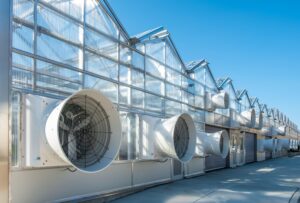
Unlike an exhaust fan, which is primarily designed to remove air from the greenhouse, a circulation fan focuses on internal air movement. It helps distribute temperature, humidity, and fresh air more evenly throughout the crop zone.
For commercial growers, this relatively simple piece of equipment can play an important role in maintaining a more consistent greenhouse climate.
What Is a Greenhouse Circulation Fan?
A greenhouse circulation fan is an electrically powered fan designed to move air horizontally or vertically within a greenhouse.
Its main function is not necessarily to remove air from the building. Instead, it keeps the internal air moving so that different areas of the greenhouse experience more uniform environmental conditions.
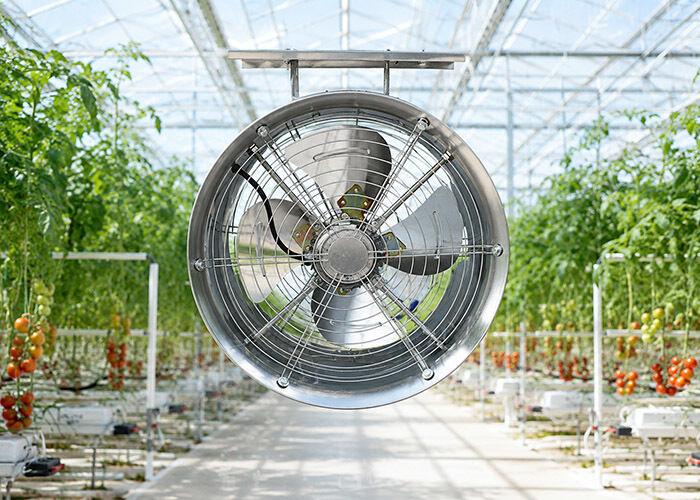
Depending on the greenhouse design, circulation fans can be installed:
- Along side walls
- Between growing rows
- Near the roof
- Along greenhouse columns
- In multiple ventilation zones
- Around dense crop areas
Commercial systems often use several fans positioned strategically to create a continuous airflow pattern.
This arrangement is sometimes referred to as horizontal airflow, particularly when fans are positioned to move air along the length of the greenhouse.
Why Internal Air Circulation Matters
A greenhouse can have excellent ventilation equipment and still suffer from uneven airflow.
For example, an exhaust fan may remove hot air from one end of a greenhouse while the opposite end remains relatively stagnant.
Similarly, cooling pads may introduce cooler air into the greenhouse, but without sufficient circulation, that air may not distribute evenly throughout the crop area.
This can create differences in:
- Temperature
- Relative humidity
- CO₂ concentration
- Transpiration
- Leaf drying
- Crop growth
A circulation fan helps reduce these variations by continuously mixing the greenhouse air.
How Does a Greenhouse Circulation Fan Work?
The principle is simple: the fan draws air in and pushes it forward, creating a controlled airflow through the greenhouse.
When multiple fans are installed, they can be arranged to create a continuous circulation loop.
A typical airflow pattern may look like this:
Fan → Horizontal Airflow → Crop Zone → Greenhouse End → Return Airflow → Fan
This creates movement throughout the greenhouse rather than allowing air to remain stationary.
The objective is not necessarily to create extremely strong airflow. Excessive air speed can be undesirable for some crops.
Instead, the system should create consistent and gentle air movement across the growing area.
Greenhouse Circulation Fan vs Exhaust Fan
These two types of fans perform different jobs.
| Feature | Circulation Fan | Exhaust Fan |
|---|---|---|
| Main Function | Move internal air | Remove greenhouse air |
| Air Exchange | Indirect | Direct |
| Installation | Inside greenhouse | Usually greenhouse wall |
| Main Benefit | Uniform climate | Heat and humidity removal |
| Airflow Direction | Horizontal/Internal | Inside → Outside |
| Suitable For | Air mixing | Ventilation |
| Can Work Together | Yes | Yes |
In a commercial greenhouse, it is common for both systems to operate together.
The exhaust fan removes warm air while the circulation fans distribute air across the growing space.
Main Benefits of a Greenhouse Circulation Fan
1. More Uniform Temperature
Air circulation helps distribute warm and cool air more evenly.
This is especially useful in large structures where the temperature near the walls, roof, and crop canopy can vary.
2. Better Humidity Distribution
Moisture generated by irrigation and plant transpiration does not remain concentrated in one area as easily when air is continuously moving.
3. Reduced Stagnant Air
Dead-air zones can develop around dense crops and greenhouse corners. Circulation fans help move air through these areas.
4. Better Crop Environment
More consistent airflow can support a healthier growing environment when combined with appropriate temperature and humidity management.
5. Improved Ventilation Efficiency
Air circulation can help distribute fresh or cooled air introduced through side vents, roof vents, or cooling pads.
6. Support for Heating Systems
During colder periods, warm air can accumulate near the upper part of a greenhouse. Circulation fans help mix this warm air with cooler air lower down.
7. Reduced Environmental Variation
Uniformity becomes increasingly important as greenhouse size increases. Multiple circulation fans can help reduce differences between growing zones.
Greenhouse Circulation Fans for Humidity Management
Humidity is one of the most important reasons to maintain internal air movement.
After irrigation or fertigation, water evaporates into the greenhouse atmosphere. Plants also release moisture through transpiration.
If the air around the crop remains stagnant, local humidity can become significantly higher than the average greenhouse reading.
Air circulation helps mix these areas.
It can also help surfaces and foliage dry more evenly when environmental conditions permit.
However, a circulation fan does not actually remove moisture from the greenhouse by itself.
For effective humidity control, it should work together with:
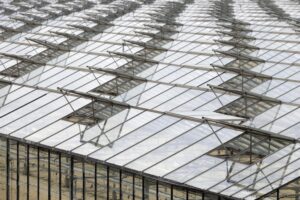
- Roof ventilation
- Side ventilation
- Exhaust fans
- Dehumidification equipment
- Heating
- Climate-control systems
This distinction is important when selecting equipment. A circulation fan improves air movement, while ventilation and dehumidification systems handle moisture removal.
Greenhouse Circulation Fan in Summer
During hot weather, circulation fans can work together with exhaust fans and evaporative cooling systems.
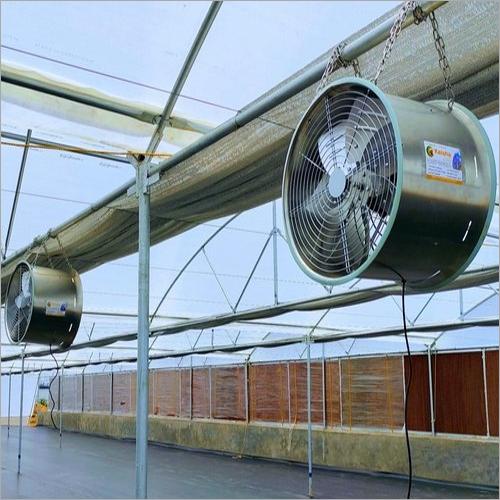
For example:
- Outside air enters through a cooling pad.
- The cooled air moves into the greenhouse.
- Circulation fans distribute the air through the crop area.
- Exhaust fans remove warmer air.
- The climate controller adjusts the equipment according to temperature and humidity.
This combination is particularly useful for larger greenhouses where one cooling point cannot provide uniform conditions throughout the entire structure.
Greenhouse Circulation Fan in Winter
Air movement is also important during colder seasons.
When a greenhouse uses heating equipment, warm air naturally rises. Without circulation, the upper section can become considerably warmer than the crop area.
Circulation fans can mix the air and help distribute heat more evenly.
This can improve the efficiency of heating equipment and reduce temperature differences between growing zones.
The fan speed should be selected carefully. The objective during winter is usually controlled air mixing rather than high-speed ventilation.
Choosing the Right Fan for Your Greenhouse
Several factors should be considered before selecting a circulation fan.
Greenhouse Size
A small greenhouse may require only a few fans, while a large multi-span structure may require multiple airflow zones.
Crop Density
Dense crops create more resistance to airflow. Fan placement should account for the height and density of the plant canopy.
Greenhouse Layout
Columns, partitions, benches, irrigation systems, and equipment can all influence airflow.
Fan Air Volume
Air volume should be matched to the size of the growing area and the required circulation pattern.
Motor Efficiency
Because circulation fans may operate for long periods, motor efficiency has a direct effect on operating costs.
Noise
For certain indoor or research environments, low-noise operation may be an important consideration.
Control Method
Fans can be operated manually, through timers, or automatically through a greenhouse climate-control system.
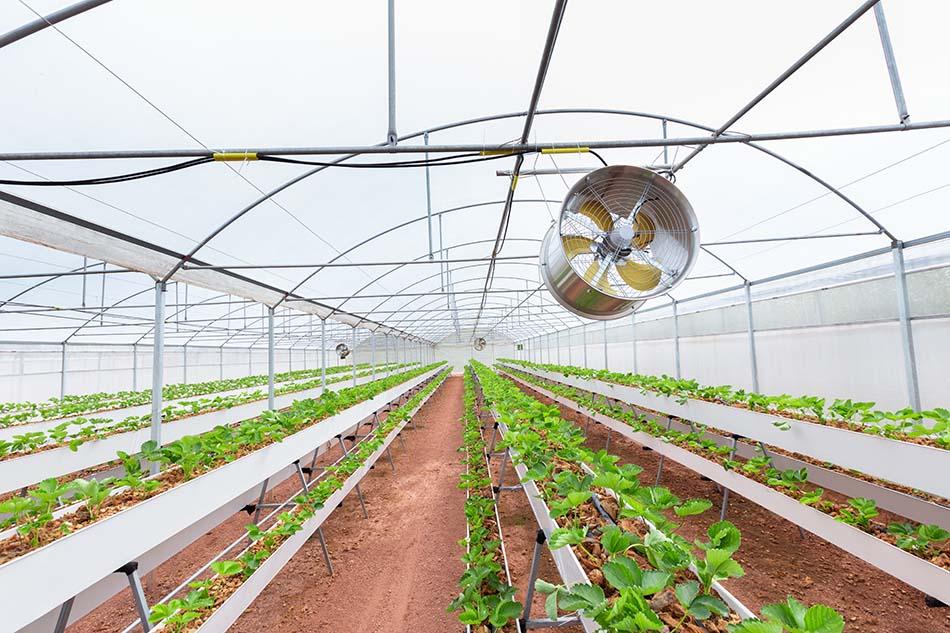
Installation and Fan Positioning
Correct installation is just as important as fan specifications.
Fans should be positioned to create a continuous airflow path instead of competing airflow directions.
In long greenhouses, fans are often arranged in sequence so that one fan pushes air toward the next section.
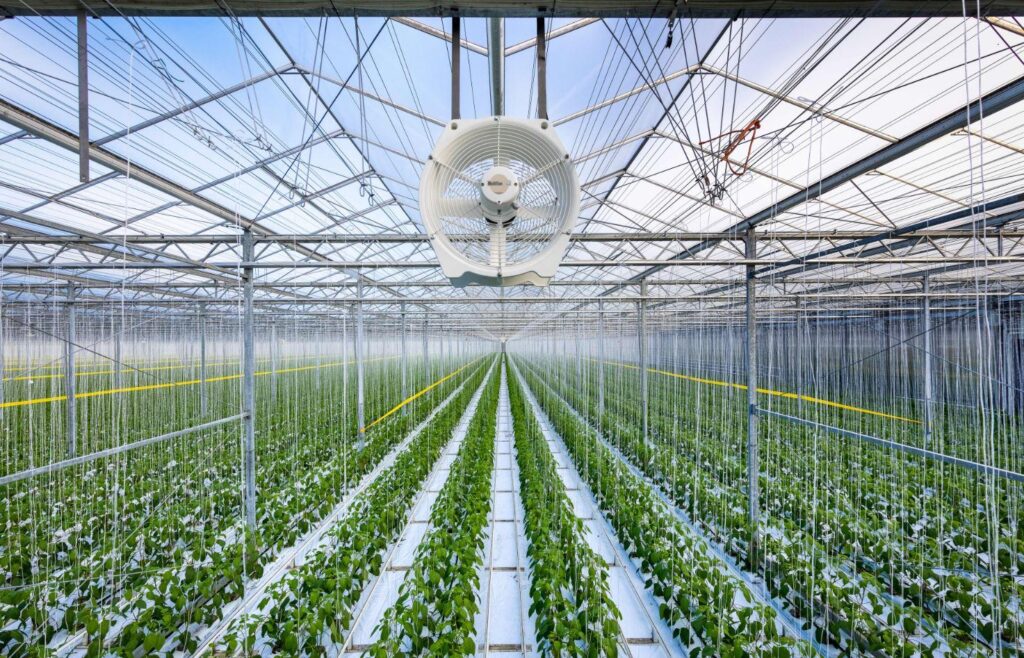
Installation should also consider:
- Crop height
- Greenhouse columns
- Roof height
- Side ventilation
- Exhaust fans
- Cooling pads
- Heating equipment
- Worker access
- Maintenance access
The goal is to avoid areas where air movement is blocked.
For large projects, airflow planning should be completed before final fan positions are determined.
Technical Parameters
| Parameter | Typical Specification |
|---|---|
| Product Type | Greenhouse Circulation Fan |
| Airflow Direction | Horizontal / Internal Circulation |
| Fan Diameter | Customized |
| Air Volume | Project Dependent |
| Motor | Efficient Electric Motor |
| Voltage | 220V / 380V / Customized |
| Frame | Galvanized Steel / Aluminum |
| Blade | Aluminum / Stainless Steel / Customized |
| Control | Manual / Timer / PLC |
| Speed Control | Optional |
| Installation | Wall / Column / Suspended |
| Noise Level | Project Dependent |
| Protection | Optional Motor Protection |
| Sensor Integration | Available |
| Application | Greenhouse / Nursery / Indoor Farming |
| Automation | Optional |
| OEM/ODM | Available |
Note: Actual airflow capacity, fan quantity, motor power, dimensions, and installation configuration should be calculated according to greenhouse size, crop density, climate conditions, and the desired airflow pattern.
Applications of Greenhouse Circulation Fans
A greenhouse circulation fan can be used across many commercial growing environments.
Vegetable Greenhouses
Suitable for tomatoes, cucumbers, peppers, lettuce, leafy greens, and other crops where consistent environmental conditions are important.
Flower Greenhouses
Air circulation can help maintain more uniform temperature and humidity around ornamental plants.
Plant Nurseries
Young plants can benefit from controlled air movement when ventilation and environmental conditions are carefully managed.
Hydroponic Facilities
Hydroponic growing environments often have high plant density and continuous water availability, making air movement an important part of climate management.
Research Greenhouses
Circulation fans can help create more uniform environmental conditions between experimental zones.
Integrating Circulation Fans with Smart Greenhouse Control
For larger agricultural projects, circulation fans can become part of an automated climate-control system.
The controller can monitor:
- Temperature
- Relative humidity
- CO₂
- Light intensity
- Time schedules
- Ventilation status
Based on the programmed settings, it can coordinate circulation fans with other greenhouse equipment.
For example, the system can increase internal air circulation when exhaust ventilation begins, or maintain lower-speed circulation during heating periods.
This approach makes the fan part of a complete environmental management system rather than an independent piece of equipment.
Greenhouse Circulation Fan from Good Growing Tech
Good Growing Tech provides greenhouse ventilation and climate-control equipment for commercial agricultural projects.
The circulation fan solution can be configured according to the greenhouse structure, crop layout, climate conditions, and automation requirements.
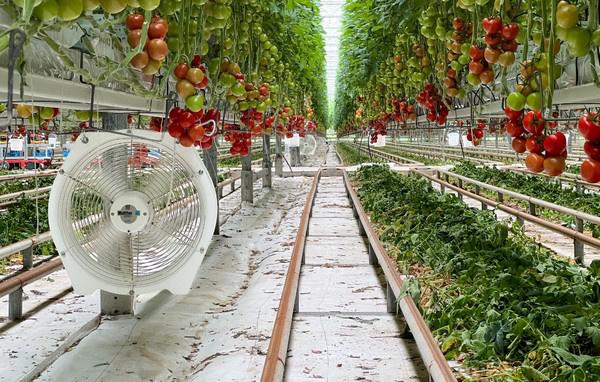
Available configurations may include:
- Internal circulation fans
- Horizontal airflow systems
- Exhaust fans
- Side ventilation
- Roof ventilation
- Cooling pads
- Heating systems
- Temperature and humidity sensors
- Automated climate controllers
For larger greenhouse projects, Good Growing Tech can help coordinate these systems so that airflow, ventilation, cooling, and heating work together rather than being designed independently.
FAQs:
1. What does a greenhouse circulation fan do?
It moves air inside the greenhouse to improve airflow uniformity and reduce stagnant zones.
2. Is a circulation fan the same as an exhaust fan?
No. An exhaust fan removes air from the greenhouse, while a circulation fan mainly moves and mixes air inside the greenhouse.
3. Do circulation fans reduce greenhouse temperature?
They can improve temperature distribution, but they are not a direct replacement for cooling equipment. For significant heat removal, exhaust fans, roof ventilation, or evaporative cooling may also be required.
4. Can circulation fans help control humidity?
They can improve humidity distribution and reduce stagnant humid areas, but they do not remove moisture by themselves.
5. How many circulation fans does a greenhouse need?
There is no universal number. The quantity depends on greenhouse dimensions, fan airflow, crop density, layout, and desired airflow pattern.
6. Can circulation fans run automatically?
Yes. They can be controlled using timers, thermostats, or an integrated greenhouse climate-control system.
7. Can circulation fans work with cooling pads?
Yes. Circulation fans can distribute cooled air from evaporative cooling systems throughout the greenhouse.
8. Can Good Growing Tech customize the fan system?
Yes. Fan specifications, mounting methods, motor configuration, control systems, and installation layouts can be customized for commercial greenhouse projects.
Conclusion
A greenhouse circulation fan is a relatively simple piece of equipment, but its role in commercial greenhouse climate management is easy to underestimate.
Exhaust fans and natural vents control air exchange with the outside environment. Circulation fans take care of what happens inside the greenhouse, helping move air through the crop area and reduce temperature and humidity differences between different zones.
For larger greenhouses, combining circulation fans with roof ventilation, side ventilation, exhaust fans, cooling pads, heating, and automatic climate controls can create a much more stable growing environment.
The correct system should always be designed around the actual greenhouse rather than selected only by fan size or motor power.
Contact Good Growing Tech
📧 Email: arno@goodgrowingtech.com
🌐 Website: www.goodgrowingtech.com
📱 WhatsApp: +86 18056416155
🏢 Good Growing Tech – Professional Greenhouse Equipment & Smart Agriculture Solutions