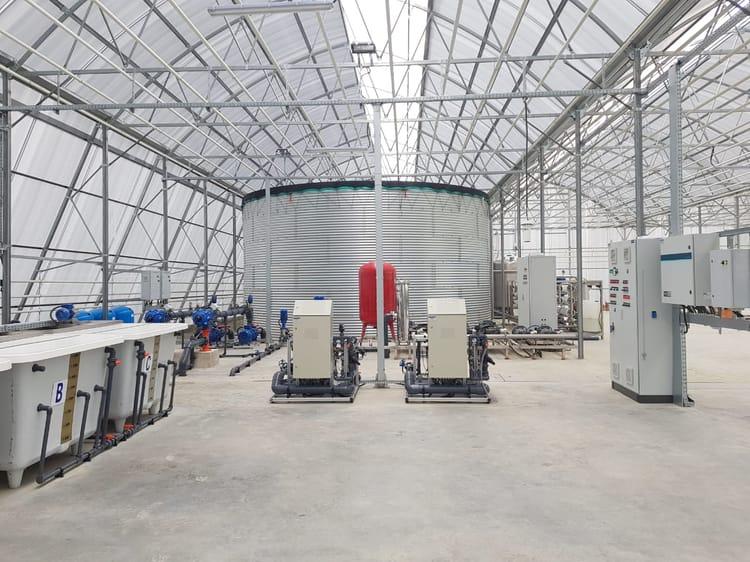
Greenhouse Fertigation System for More Efficient Crop Production
In commercial greenhouse production, water and fertilizer are closely connected. Delivering enough water is only part of the job; crops also need the right nutrients at the right time. A greenhouse fertigation system combines irrigation and fertilizer application into one controlled process, giving growers a more consistent way to manage crop nutrition.
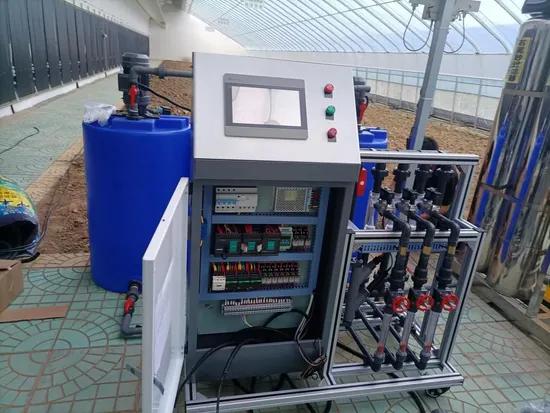
Instead of mixing fertilizer manually for every irrigation cycle, a fertigation setup can inject dissolved nutrients into the irrigation water and distribute them directly to the growing area. Depending on the project, the system can range from a simple fertilizer injector to a fully automated solution with dosing pumps, EC and pH monitoring, valves, sensors, and greenhouse climate controls.
For commercial growers, this means better control over inputs, less unnecessary labor, and a more repeatable growing process.
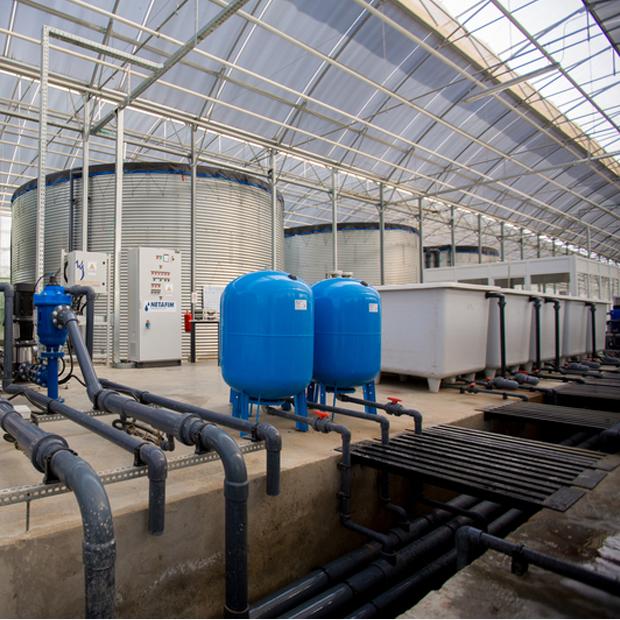
What Is a Greenhouse Fertigation System?
A greenhouse fertigation system is designed to add soluble fertilizer to irrigation water before it reaches the plants.
The basic process is straightforward:
Water source → Filtration → Fertilizer mixing → Dosing/injection → Irrigation lines → Plants
More advanced systems can continuously monitor parameters such as electrical conductivity (EC), pH, water flow, pressure, and irrigation duration. A controller can then adjust fertilizer dosing according to the programmed growing schedule or target conditions.
This approach is particularly useful in greenhouses where growers need consistent nutrition across hundreds or thousands of plants.
How Does Greenhouse Fertigation Work?
A properly designed system usually contains several stages.
1. Water Filtration
Clean irrigation water is essential. Filters remove suspended particles that could block drip emitters, valves, or other irrigation components.
The filtration method depends on the quality of the incoming water. Screen, disc, sand, or other filtration solutions can be selected according to the project.
2. Fertilizer Mixing
Water-soluble fertilizers are prepared in a fertilizer tank or mixing unit. Some commercial installations use separate tanks for different fertilizer solutions to improve nutrient management and reduce compatibility problems.
3. Fertilizer Injection
An injector or dosing pump introduces fertilizer concentrate into the irrigation water.
Common approaches include:
- Multi-channel automatic dosing systems
- Venturi fertilizer injectors
- Dosing pumps
- Proportional fertilizer injectors
The right option depends on greenhouse size, required dosing accuracy, water flow, and automation requirements.
4. EC and pH Monitoring
For advanced crop production, EC and pH sensors can provide valuable information about the irrigation solution.
EC can be used as an indicator of dissolved nutrient concentration, while pH monitoring helps growers maintain a suitable nutrient solution range for the crop.
5. Irrigation Distribution
After mixing, the nutrient solution travels through the irrigation network.
Drip lines are widely used because they can deliver water and nutrients close to the root zone. Other distribution methods can also be integrated depending on the crop and growing system.
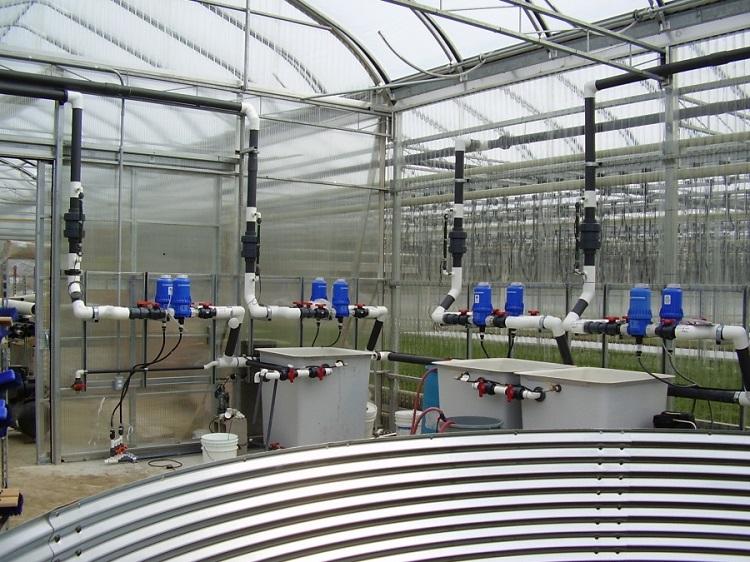
Main Components of a Commercial Fertigation System
A commercial installation may include the following equipment:
| Component | Main Function |
|---|---|
| Water Pump | Provides required water pressure and flow |
| Filtration Unit | Removes particles from irrigation water |
| Fertilizer Tank | Stores concentrated fertilizer solution |
| Mixing Tank | Prepares fertilizer solution |
| Dosing Pump | Controls fertilizer injection |
| Venturi Injector | Uses water flow to draw fertilizer solution |
| EC Sensor | Monitors solution conductivity |
| pH Sensor | Monitors acidity/alkalinity |
| Solenoid Valves | Controls irrigation zones |
| Flow Meter | Measures water delivery |
| Pressure Sensor | Monitors system pressure |
| Controller | Coordinates irrigation and fertigation |
| Drip Lines | Deliver nutrient solution to plants |
Not every greenhouse needs all of these components. A small nursery may use a relatively simple injector, while a large multi-zone greenhouse may benefit from a centralized automated dosing station.
Why Use Fertigation in Commercial Greenhouses?
More Precise Nutrient Delivery
Traditional fertilizer application can make it difficult to maintain uniform nutrition throughout a large growing area. Fertigation allows fertilizer to be delivered together with irrigation water, helping distribute nutrients more consistently.
Less Fertilizer Waste
Applying nutrients through controlled irrigation can reduce unnecessary fertilizer use. Instead of applying large quantities at fixed intervals, growers can adjust nutrient concentration and irrigation frequency according to crop requirements.
This can be particularly valuable when fertilizer costs are significant.
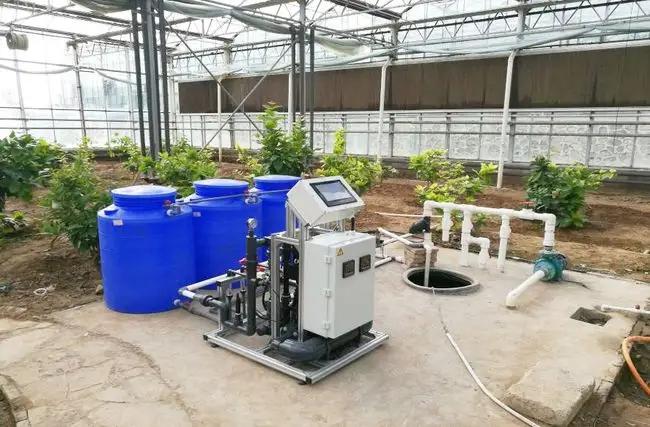
Lower Labor Requirements
Manual fertilizer mixing and distribution can take considerable time in a commercial greenhouse.
Once the system is properly configured, automated dosing and irrigation can handle much of the repetitive work. Operators can focus more on crop inspection, maintenance, harvesting, and other important tasks.
Better Crop Uniformity
When water and nutrients are distributed consistently, plants are more likely to experience similar growing conditions. This can help commercial growers achieve more predictable crop development across different production zones.
Easier Irrigation Management
A modern fertigation setup does more than inject fertilizer. It can become part of the greenhouse’s wider irrigation management system, controlling irrigation zones, timing, flow, and nutrient concentration.
Fertigation with Drip Irrigation
Drip irrigation is a natural partner for fertigation because water and nutrients can be delivered directly toward the root zone.
For example, a commercial vegetable greenhouse may divide the growing area into several irrigation zones. Each zone can be controlled through valves, allowing the operator to adjust irrigation according to crop variety, plant age, substrate, or greenhouse section.
This zoning approach can be particularly useful in large projects where different crops have different nutrient and water requirements.
Good system design should consider:
- Drainage requirements
- Pipe diameter
- Water pressure
- Flow rate
- Irrigation zone size
- Dripper spacing
- Filter capacity
- Fertilizer compatibility
- Pump performance
Fertigation for Hydroponic and Soilless Growing
Fertigation is also widely suited to hydroponic and soilless production.
In these systems, the nutrient solution plays an even more important role because plants may have limited access to nutrients outside the controlled irrigation solution.
An automated setup can monitor EC and pH and manage nutrient solution delivery according to the production strategy.
For hydroponic projects, however, the fertigation system should be designed together with the specific growing method. NFT, Dutch buckets, substrate bags, coco-based systems, and other production methods can have different water-flow and nutrient-management requirements.
Manual, Semi-Automatic, or Fully Automatic?
There is no single solution for every greenhouse.
Manual Fertigation
Suitable for smaller operations where fertilizer is prepared and adjusted by an operator.
Advantages: simple structure and lower initial investment.
Semi-Automatic Fertigation
The operator controls some parameters while pumps, valves, or timers automate repetitive tasks.
Advantages: a good balance between cost and convenience.
Fully Automatic Fertigation
A controller manages dosing, irrigation schedules, valves, and potentially EC and pH feedback.
Advantages: high consistency, reduced labor, and better suitability for large commercial operations.
How to Choose the Right Fertigation System
Before purchasing equipment, buyers should consider the entire irrigation project rather than selecting a fertilizer injector alone.
Greenhouse Size
The required pump, fertilizer dosing capacity, pipe network, and number of irrigation zones will change significantly between a small greenhouse and a large commercial installation.
Crop Type
Tomatoes, cucumbers, leafy vegetables, flowers, nursery plants, and other crops may have different irrigation and nutrient-management requirements.
Water Quality
Water analysis is an important starting point. Existing mineral content, suspended particles, pH, and other water characteristics can influence filtration and nutrient management.
Required Automation
If labor reduction and centralized management are priorities, an automated controller with sensors and dosing equipment may be appropriate.
Fertilizer Compatibility
Not all fertilizers should be mixed together. A proper system should account for fertilizer solubility, compatibility, and the possibility of precipitation or blockage.
Technical Parameters
The following specifications are typical project references rather than fixed product values. Final configurations should be selected according to greenhouse size, crop, water source, and irrigation design.
| Parameter | Typical Configuration |
|---|---|
| System Type | Fertigation / Nutrient Dosing System |
| Fertilizer Method | Venturi / Dosing Pump / Proportional Injection |
| Fertilizer Tanks | Single / Multiple |
| Filtration | Screen / Disc / Sand / Customized |
| EC Monitoring | Optional |
| pH Monitoring | Optional |
| Flow Monitoring | Optional |
| Pressure Monitoring | Optional |
| Irrigation Control | Manual / Timer / Automatic |
| Controller | Digital Controller / PLC / Customized |
| Irrigation Zones | Customized |
| Water Source | Tank / Well / Municipal / Customized |
| Irrigation Method | Drip / Sprinkler / Hydroponic |
| Communication | Wired / RS485 / Internet / Customized |
| Remote Monitoring | Optional |
| Fertilizer Dosing | Manual / Semi-Automatic / Automatic |
| Application | Greenhouse / Nursery / Indoor Farming |
| OEM/ODM | Available |
Maintenance Tips for Long-Term Operation
Even a highly automated fertigation system needs regular maintenance.
Clean filters regularly. A blocked filter can reduce pressure and affect irrigation uniformity.
Flush irrigation lines. Fertilizer residue and mineral deposits can accumulate inside pipes and emitters.
Check dosing equipment. Pumps and injectors should be inspected to ensure consistent fertilizer delivery.
Calibrate sensors. EC and pH sensors require periodic calibration to maintain reliable readings.
Inspect valves and connections. Small leaks or damaged fittings can eventually create significant water-management problems.
Review fertilizer compatibility. Proper storage and mixing practices help prevent precipitation and clogging.equipment designed around the structure rather than a one-size-fits-all product.
Greenhouse Fertigation Solutions from Good Growing Tech
Good Growing Tech provides greenhouse equipment and integrated agriculture solutions for commercial growers. Instead of treating irrigation, fertigation, ventilation, cooling, and environmental control as separate systems, projects can be designed around the actual production requirements.
A fertigation solution can be customized according to greenhouse dimensions, crop type, irrigation method, water source, required automation level, and budget.
Whether the project needs a basic fertilizer injection unit or a more advanced automated nutrient management system, the goal is the same: deliver water and nutrients more efficiently while making greenhouse production easier to manage.
FAQs:
What is the main purpose of a greenhouse fertigation system?
Its main purpose is to combine irrigation and fertilizer application so crops receive water and dissolved nutrients through a controlled distribution system.
Is fertigation suitable for small greenhouses?
Yes. Smaller greenhouses can use simple fertilizer injectors or compact dosing systems. The equipment can be scaled according to water flow and production requirements.
Can fertigation work with drip irrigation?
Yes. Drip irrigation is one of the most common distribution methods because it can deliver nutrient solution close to the crop root zone.
Do I need EC and pH sensors?
Not necessarily. They are particularly useful for automated systems and crops that require precise nutrient-solution management, but simpler installations may operate without them.
What fertilizer can be used?
Water-soluble fertilizers designed for fertigation can generally be considered, but compatibility, solubility, and crop requirements should be checked before use.
Can the system be automated?
Yes. Automated systems can integrate pumps, valves, dosing equipment, EC/pH sensors, irrigation schedules, and greenhouse controllers.
Conclusion
A well-designed greenhouse fertigation system can make commercial crop production more consistent and easier to control. By combining irrigation with accurate fertilizer dosing, growers can improve nutrient distribution, reduce repetitive manual work, and make better use of water and fertilizer.
The best system is not necessarily the most complicated one. It is the system that matches the greenhouse size, crop, irrigation method, water quality, production goals, and desired level of automation.
Contact Good Growing Tech
📧 Email: arno@goodgrowingtech.com
🌐 Website: www.goodgrowingtech.com
📱 WhatsApp: +86 18056416155
🏢 Good Growing Tech – Professional Greenhouse Equipment & Smart Agriculture Solutions