Greenhouse Cooling Pad for Efficient Commercial Greenhouse Cooling
Temperature management is one of the biggest challenges in modern greenhouse production. During periods of strong sunlight, the temperature inside a greenhouse can rise rapidly, creating an environment that is difficult for many crops to tolerate.
Excessive heat can affect photosynthesis, water absorption, flowering, fruit development, and overall crop quality. For commercial growers, these problems can quickly translate into lower yields and higher operating costs.
A greenhouse cooling pad provides an efficient way to reduce excessive heat through evaporative cooling. When combined with exhaust fans, water circulation equipment, and climate controllers, cooling pads can become part of a complete environmental control system for commercial agriculture.
This type of cooling solution is particularly useful for vegetable farms, flower production facilities, nurseries, hydroponic greenhouses, and other controlled-environment agriculture projects.
What Is a Greenhouse Cooling Pad?
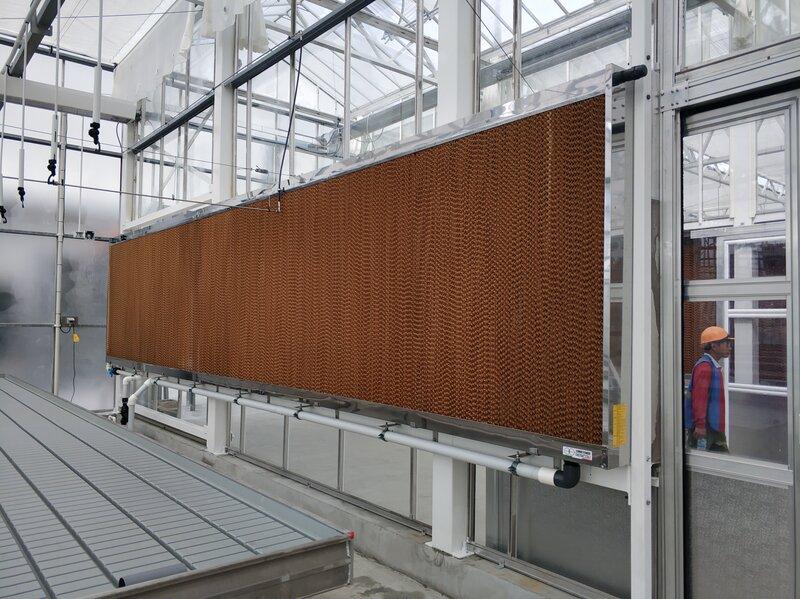
A greenhouse cooling pad is an evaporative cooling component installed on one side of a greenhouse. Water continuously flows over the surface of the pad while hot outside air is drawn through it by exhaust fans.
As the air passes through the wet pad, part of the water evaporates. The evaporation process absorbs heat from the incoming air, reducing its temperature before the air enters the growing area.
The cooled air then moves through the greenhouse and is eventually pulled outside by exhaust fans.
A complete evaporative cooling setup generally includes:
- Cooling pads
- Water circulation pipes
- Water pump
- Water tank
- Distribution system
- Exhaust fans
- Temperature controller
- Humidity sensors
The components work together to provide continuous air exchange and temperature management.
How Does an Evaporative Cooling System Work?
The operating principle is relatively simple, which is one reason this technology has become popular in commercial agriculture.
Step 1: Water Distribution
A pump moves water from the reservoir to the upper distribution pipe.
Step 2: Pad Wetting
Water flows evenly down through the cooling material, keeping the pad surface continuously wet.
Step 3: Hot Air Enters
Outdoor air is pulled through the wet material by exhaust fans.

Step 4: Evaporation Takes Place
Water evaporates as air passes through the pad, absorbing heat from the incoming airflow.
Step 5: Cooled Air Enters the Greenhouse
The cooled air moves through the cultivation area, helping reduce the internal temperature.
This continuous process can be particularly effective in hot and relatively dry climates.
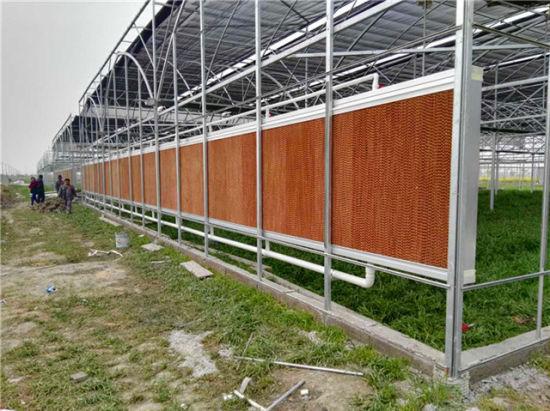
Why Commercial Growers Choose Greenhouse Cooling Pads
1. Effective Temperature Reduction
One of the main reasons growers install a greenhouse cooling pad is to reduce heat accumulation.
When outdoor temperatures rise, natural ventilation alone may not provide enough cooling. An evaporative system provides additional cooling capacity by lowering the temperature of incoming air.
This can help create a more stable environment for crops during hot weather.
2. Reduced Heat Stress
Plants can become stressed when exposed to excessive temperatures for extended periods.
Heat stress may lead to:
- Reduced photosynthesis
- Leaf damage
- Flower drop
- Poor fruit development
- Increased water consumption
- Uneven crop growth
By reducing the temperature inside the greenhouse, evaporative cooling can help protect crops during periods of high solar radiation.
3. Works With Exhaust Fans
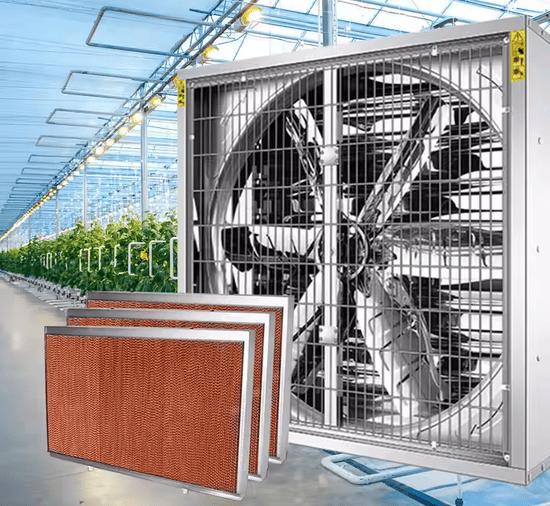
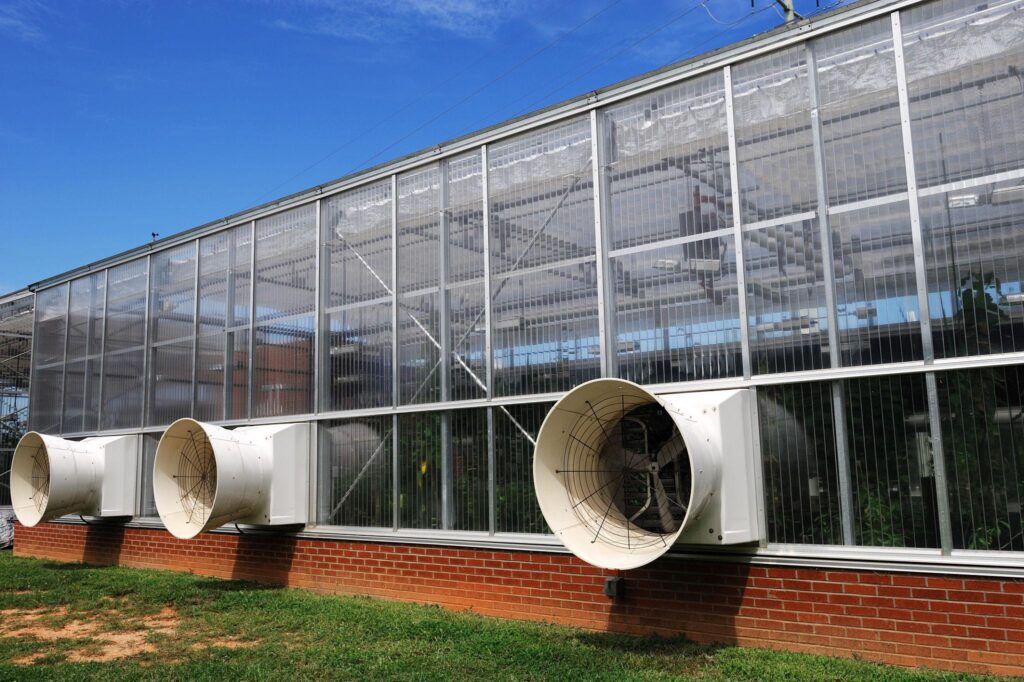
Cooling pads are usually installed together with industrial exhaust fans.
The fans create airflow through the greenhouse, while the pads cool incoming air.
This combination provides a more effective solution than relying on either component independently.
For larger commercial projects, multiple fan-and-pad sections can be installed according to greenhouse dimensions and local climate conditions.
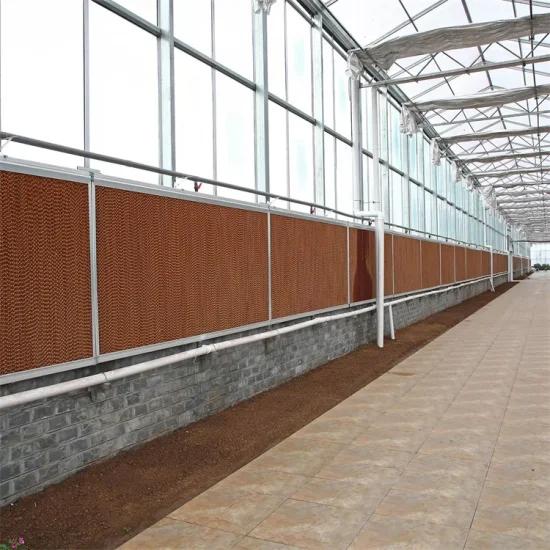
Greenhouse Cooling Pad Material and Construction
The quality of the cooling material has a direct influence on cooling performance and service life.
Commercial cooling pads are commonly manufactured using specially treated cellulose material designed to absorb and distribute water efficiently.
Important characteristics include:
High Water Absorption
The material should absorb water quickly and distribute it evenly across the pad surface.
Large Evaporation Area
A structured surface provides a larger contact area between air and water, improving evaporation efficiency.
Structural Stability
The pad should maintain its shape during continuous wetting and airflow.
Long-Term Durability
High-quality materials can withstand repeated operation in humid greenhouse environments.
Easy Maintenance
The structure should allow growers to inspect, clean, and replace the pad when required.
Applications for Different Agricultural Projects
A commercial greenhouse cooling pad system can be used across a wide range of cultivation projects.
Vegetable Greenhouses
Vegetable crops such as tomatoes, cucumbers, peppers, and leafy greens can benefit from more stable summer temperatures.
Flower Greenhouses
Many ornamental plants and flowers are sensitive to excessive heat. Controlled cooling can help maintain more suitable growing conditions.
Nursery Greenhouses
Young plants and seedlings often require more stable environmental conditions. Cooling systems can help prevent excessive temperature fluctuations.
Hydroponic Greenhouses
Hydroponic production depends heavily on environmental control. Temperature management is particularly important because crops may grow at high planting densities.
Hemp and Specialty Crop Facilities
Controlled cooling can be integrated with ventilation, lighting, irrigation, and automation systems for specialized commercial cultivation environments.
How to Select the Right Cooling Pad System
Choosing equipment based only on greenhouse area is not enough. Several factors should be evaluated before purchasing.
Greenhouse Size
Larger structures require greater airflow and a larger cooling area.
Local Climate
Hot and dry climates are generally more suitable for evaporative cooling. Local humidity should also be considered when designing the system.
Crop Requirements
Different crops have different temperature and humidity requirements.
Exhaust Fan Capacity
The cooling pad and exhaust fans must be properly matched. Insufficient airflow can reduce the effectiveness of the entire system.
Water Quality
Water containing excessive minerals or impurities can cause deposits on the pad surface. A suitable filtration and water management system can help extend service life.
Automation Requirements
Commercial farms may integrate temperature and humidity sensors so that cooling equipment can operate automatically.
Technical Parameters
| Parameter | Typical Specification |
|---|---|
| Cooling Type | Evaporative Cooling |
| Core Material | Treated Cellulose |
| Pad Height | Customized |
| Pad Thickness | 100 / 150 / 200 mm |
| Water Circulation | Automatic Pump |
| Water Distribution | Top Distribution Pipe |
| Installation | Greenhouse Side Wall |
| Control Mode | Manual / Automatic |
| Fan Integration | Supported |
| Application | Commercial Agriculture |
| Customization | Available |
Final specifications should be confirmed according to greenhouse dimensions, climate conditions, airflow requirements, and project design.
Greenhouse Cooling Pad vs. Traditional Air Conditioning
For large agricultural structures, traditional air conditioning can become expensive because of the large internal volume that needs to be cooled.
Evaporative cooling provides a different approach.
Instead of mechanically lowering the temperature of the entire greenhouse, the system uses water evaporation and forced airflow to cool incoming air.
This can provide several advantages for agricultural applications:
- Lower equipment complexity
- Reduced electricity requirements
- High airflow capacity
- Suitable for large greenhouse structures
- Easy integration with ventilation equipment
For commercial farms, this makes evaporative cooling an attractive option when designing a climate management system.
Maintenance and Service Considerations
Regular maintenance is important for keeping the cooling system operating efficiently.
Growers should periodically inspect:
- Cooling pad surfaces
- Water distribution pipes
- Pump operation
- Water tank condition
- Filters
- Exhaust fans
- Drainage system
Mineral buildup should be controlled because deposits can reduce water distribution and airflow through the pad.
Cleaning the water circulation system and checking the pump regularly can also help prevent unexpected downtime.
For large agricultural facilities, establishing a seasonal maintenance schedule is recommended before the hottest production period begins.
Why Choose Good Growing Tech?
Good Growing Tech provides complete greenhouse climate-control solutions for commercial agriculture projects.
Our solutions can combine:
✔ Evaporative cooling pads
✔ Industrial exhaust fans
✔ Air circulation fans
✔ Automatic ventilation
✔ Temperature and humidity sensors
✔ Smart climate controllers
✔ Irrigation and water circulation equipment
✔ Customized greenhouse engineering
Instead of supplying an individual component without considering the overall project, we can help buyers select compatible equipment according to greenhouse size, crop requirements, climate conditions, and expected production capacity.
This makes the system easier to manage and provides a more practical solution for commercial greenhouse construction and upgrades.
FAQs:
What is a greenhouse cooling pad used for?
It is used to cool incoming air through water evaporation, helping reduce greenhouse temperatures during hot weather.
Can cooling pads work without exhaust fans?
They can be wetted without fans, but effective evaporative cooling generally requires sufficient airflow. Fan-and-pad systems are commonly used for commercial applications.
What material are greenhouse cooling pads made from?
Commercial pads are commonly manufactured from treated cellulose material designed for efficient water absorption and evaporation.
Are cooling pads suitable for large greenhouses?
Yes. Multiple pad sections and industrial exhaust fans can be designed for large commercial structures.
How often should cooling pads be replaced?
Service life depends on water quality, operating frequency, maintenance, and environmental conditions. Regular inspection helps determine when replacement is necessary.
Can the cooling system be automated?
Yes. Temperature and humidity sensors can be connected to controllers to automatically operate pumps and exhaust fans according to preset conditions.
Conclusion
A properly designed greenhouse cooling pad system can play an important role in maintaining stable environmental conditions during hot weather. By combining evaporative cooling with exhaust ventilation, growers can reduce heat stress, improve airflow, and create a more suitable environment for commercial crop production.
For large agricultural projects, the most effective approach is not simply choosing the largest fan or the thickest cooling pad. The entire system—including greenhouse dimensions, airflow, water circulation, climate conditions, crop requirements, and automation—needs to work together.
Good Growing Tech can provide customized greenhouse cooling and climate-control solutions for commercial growers, distributors, and agricultural project developers.
Contact Us
📧 Email: arno@goodgrowingtech.com
🌐 Website: www.goodgrowingtech.com
📱 WhatsApp: +86 18056416155
🏢 Good Growing Tech – Professional Greenhouse Cooling & Smart Agriculture Solutions